Title: Acoustic Backscatter Network for Vehicle Body-in-White
Author: Weiguo Wang (NIO, Tsinghua University); Yuan He, Yadong Xie, Chuyue Xie (Tsinghua University); Yi Kai, Chengchen Hu (NIO)
Scribe: Letian Zhu (Xiamen University)
Introduction
Body-in-White (BiW), the fundamental metallic structure of vehicles, requires continuous structural health monitoring for safety and performance. However, existing monitoring approaches face significant challenges. Wired sensors introduce integration complexity, weight, and material costs, with modern vehicles already containing thousands of wires totaling several kilometers. Wireless sensors using WiFi, BLE, or ZigBee are infeasible due to the metallic BiW severely impeding RF signal propagation, while battery-powered solutions require regular maintenance that becomes cumbersome due to difficult sensor access. These limitations make conventional solutions impractical for large-scale BiW monitoring, leaving a critical gap in automotive structural health monitoring capabilities.
Key idea and contribution
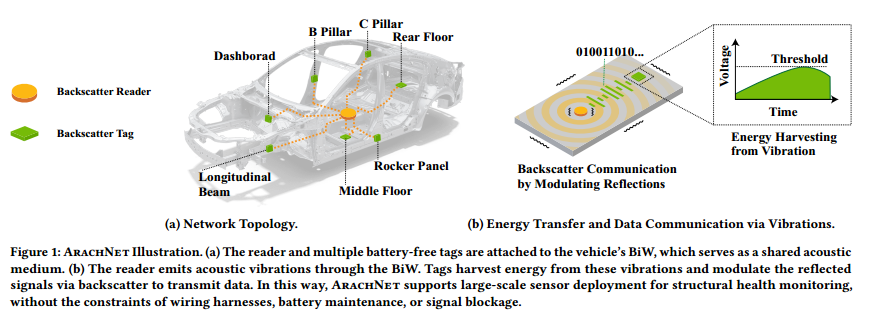
The authors propose ArachNet, a novel acoustic backscatter network that treats the BiW itself as both a power conduit and a communication channel. Instead of fighting against the metallic structure, ArachNet leverages the conductive properties of BiW to propagate vibration signals for dual purposes: energy transfer and data communication. The system comprises battery-free tags that harvest energy from BiW vibrations generated by a central reader, and use acoustic backscatter techniques to communicate by modulating reflections of these vibrations. The key innovations include: (1) an ultra-low power backscatter tag design with multi-stage voltage amplifiers and low-voltage cutoff circuits to enable activation and sustained operation under limited charging power, (2) an interrupt-driven software architecture that keeps the CPU in low-power mode except when necessary, and (3) a distributed slot allocation protocol that coordinates tags with diverse transmission requirements while maintaining limited communication overhead through predictable traffic patterns and NACK-based collision handling.
Evaluation
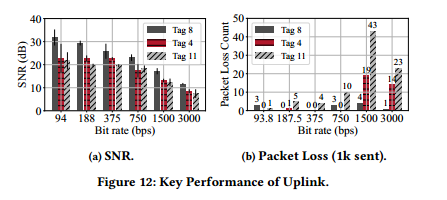
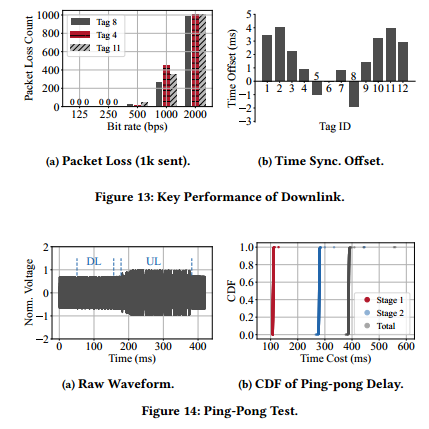
The authors implemented and deployed ArachNet on a real electric SUV BiW with 12 tags distributed across the front row, second row, and cargo areas. The system demonstrates impressive energy efficiency with tag power consumption of only 51.0 μW for uplink transmission and 24.8 μW for downlink reception. The distributed slot allocation protocol achieves up to 81.2% slot utilization while effectively handling beacon loss and late-arriving tags. Acoustic communication operates at 90 kHz (resonant frequency), showing robust performance with minimal interference from vehicle self-vibrations (below 0.1 kHz). This result is significant because it represents the first practical demonstration of using a vehicle’s structural framework as a complete networking infrastructure, potentially revolutionizing automotive sensor deployment by eliminating wiring complexity while enabling battery-free operation for long-term structural monitoring.
Question
Q1: Do you have any intuition about how your protocol scales with more tags? How many tags do we need for a car?
A1: There are two aspects to consider: how many tags we need for structural health monitoring, and how the protocol performs with different numbers of tags. For the car structure, there are key structural components that act like fuses - they collapse first during crashes. We only need to deploy tags on these key structures, so 10 to 20 tags are sufficient for structural health monitoring. For battery monitoring, 4 to 5 tags are enough. If we want to replace most cables and collect telemetry from different vehicle components, we would need additional tags accordingly.
Q2: When a car typically runs for 20-30 years, do you foresee problems with these tags since they have to be adhesively attached to the vehicle body? Are there issues with aging or performance degradation over time?
A2: We focus more on the battery-free aspect. We believe that when there’s no battery requirement, the node can last forever, at least in terms of battery and energy. The node material itself might degrade over time, but we didn’t test that specific aspect in this work.
Q3: You use acoustic signals for both sensing and communication, right? So it serves dual purposes?
A3: We currently focus on communication and networking, not sensing. We actually provide a sensor node that includes a sensor interface. You can add sensors on demand. So we deploy those tags to send sensor data and use acoustic communication to transmit the data back.
Q4: Before this work, do we have any other methods to detect the health of the Body-in-White? Since this is a safety issue, why not combine all these methods together to achieve high safety for drivers?
A4: The acoustic method is used for communication, not for detecting health. To monitor the health, we use separate sensor modules that can be attached to the tags.
Personal thoughts
ArachNet represents a paradigm shift in automotive sensing by transforming the BiW from a passive structure into an active communication medium. The hardware-software co-design is impressive, particularly the sub-Nyquist sampling and interrupt-driven architecture that achieves ultra-low power operation. The distributed protocol elegantly handles the unique challenges of acoustic backscatter networking. However, the throughput limitations (hundreds of bps) may constrain applications beyond basic monitoring, and the dependency on specific structural properties may limit generalizability across different vehicle designs. The work opens exciting possibilities for infrastructure-as-medium communication in other metallic structures like buildings or bridges.