Title: Beyond Access: How Networking Research Can Inform Policy
Host: Shadi Hassan (SIGCOMM’25 Panel Chair)
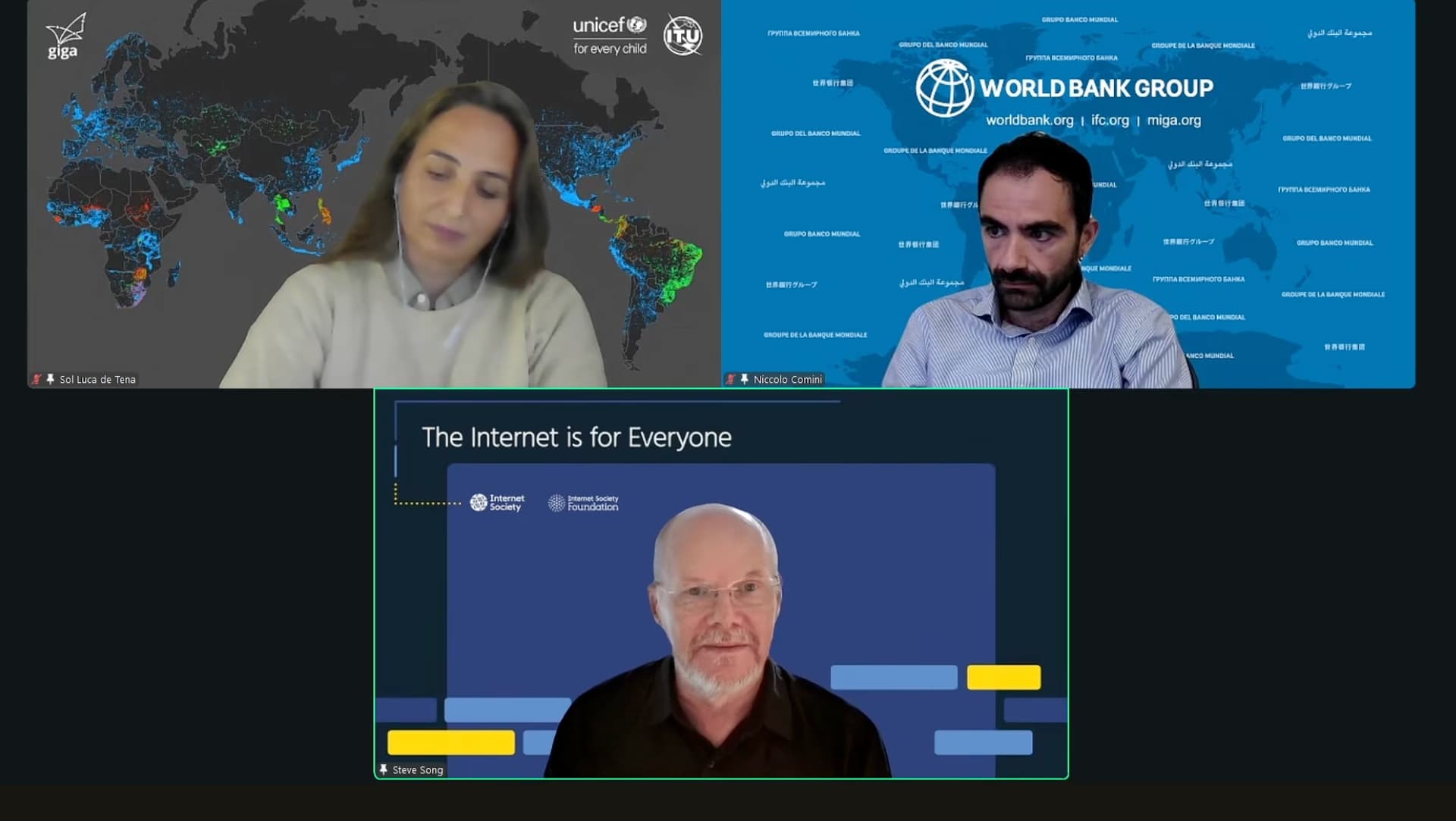
Panelists: Niccolò Comini (World Bank), Mike Jensen (Association for Progressive Communications), Soledad Luca de Tena (UNICEF Giga), Steve Song (Internet Society)
Scribe: Haodong Chen (Xiamen University)
Introduction
While the spread of mobile networks and devices has brought broadband infrastructure within physical reach of most people, a stubborn “usage gap” remains: nearly 40% of the world’s population still does not use the Internet. Barriers extend beyond mere access to include affordability, service quality and reliability, user capacity and digital literacy, as well as censorship, conflict, and discrimination along gender and racial lines. Addressing these challenges requires policy—grounded in high-quality, actionable data to guide resource allocation and evaluate outcomes—rather than technology alone. Research from the SIGCOMM community deepens understanding of how today’s Internet works, but turning academic insights into policy impact means recognizing how policymakers use data, what evidence they consider actionable, and how research can better support evidence-based governance. This non-paper session convenes practitioners from the World Bank, APC, UNICEF Giga, and the Internet Society to examine how network and non-network data inform coverage mapping, funding targeting, and investment decisions, to surface both successes and failures in academic–policy engagement, and to foster deeper collaboration between SIGCOMM and broadband policy stakeholders.

Questions & Perspectives
Key Questions Explored
- Which policy levers most effectively extend meaningful and affordable connectivity beyond urban areas?
- What data and evidence are actually usable by regulators and capable of changing decisions?
- How can academia align with policy timelines and report impacts in jobs, education, and health—not just technical metrics?
- Which market and licensing models allow small/community networks to coexist alongside incumbents?

Panelist Perspectives
- Steve Song: Advance transparency and open standards for coverage, fiber, and spectrum; use policy to support a diverse access ecosystem (municipal, community-owned, research/education networks) and temper monopoly dynamics.
- Niccolò Comini: Put policy first to unlock investment and policy-based lending; quantitatively link digital adoption to socioeconomic outcomes; align research with decision windows.
- Soledad Luca de Tena: Turn complex datasets into implementation tools (e.g., school connectivity maps and live telemetry) for cross-ministerial coordination and performance tracking.
- Mike Jensen: Build regulatory capacity and modernize licensing for small providers; prioritize affordability and innovation for bandwidth-constrained regions over binary “connected/unconnected” metrics.
Discussion
Q1: What data moves policy? Actionable, simple, and frequently updated datasets—georeferenced schools and towers, fiber PoPs, real-time connectivity status, and affordability benchmarks—expose gaps, support cost modeling, and enable inter-agency coordination.
Q2: How to bridge policy and implementation? Use a unified national mapping portal to consolidate data, adopt common standards and baselines to track progress, and maintain public delivery dashboards that clarify responsibilities, milestones, and spending so budgeting and audits are evidence-based.
Q3: How should academia match policy cadence? Co-define problems with agencies, deliver in time for budget and program decisions, and translate technical results into quantifiable socioeconomic impacts; start with small pilots and rapid iteration, then package findings into concise policy briefs with reusable data/code.
Personal Thoughts
Think of connectivity not just as technology but as a policy–data–finance loop: transparency and standards make unmet needs visible; quantifiable evidence links connectivity to tangible gains in learning, jobs, and health; inclusive licensing and capacity building broaden who can build and sustain networks. For researchers, the most useful contribution is localized, measurable, and reusable evidence—ideally with datasets and code—condensed into a one-to-two-page brief that drops directly into the policy toolkit, helping governments prioritize, evaluate impact, and move resources during real decision windows.