Title: Concurrent OFDM Backscatter with a Single Commercial Receiver
Authors: Caihui Du, Jihong Yu (Beijing Institute of Technology); Rongrong Zhang (Capital Normal University)
Scribe: Xiaoqiang Zheng (Xiamen University)
Introduction:
Concurrent OFDM backscatter lets many ultra-low-power IoT tags share one exciter, but earlier systems face three problems. Amplifier-based synchronization consumes power and works over short distances. Frequency-domain separation is vulnerable to subcarrier distortion and interference. Commercial Wi-Fi receivers also reconstruct subcarriers after FEC, preventing direct decoding. NanoScatter uses a non-ISM frequency and a USRP receiver, but its cost limits deployment.
C2Scatter addresses these limits with one commercial OFDM Wi-Fi receiver. It combines pulling-driven synchronization with delay-domain division and validates the design indoors, outdoors, and in smart-home sensing.
Key idea and contribution:
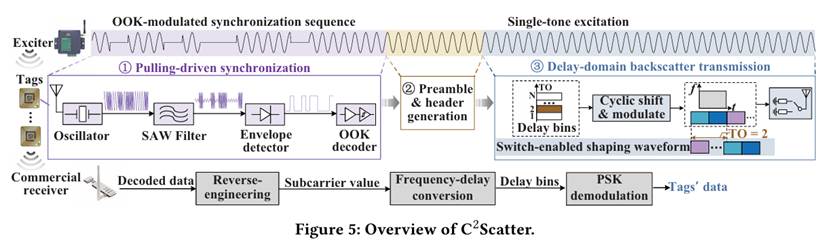
C2Scatter combines three components in one pipeline: an exciter, multiple tags, and an unmodified commercial OFDM Wi-Fi NIC. The exciter sends an OOK synchronization sequence followed by a single-tone carrier. Each tag uses a low-Q oscillator and a SAW-filter-based detector; injection pulling converts a weak synchronization signal into a detectable frequency and amplitude change without an amplifier.
After synchronization, tags generate standard-compliant Wi-Fi preambles and headers with passive RF switches, then cyclically shift the same precomputed waveform by different time offsets. These offsets create delay bins for concurrent tags. The receiver reverse-engineers the FEC output, reconstructs approximate subcarriers, converts them to the delay domain, and demodulates tags in parallel. Subcarrier distortion is spread over the delay-domain floor instead of concentrating on one subcarrier.
An offline simulated-annealing-assisted ADMM procedure designs the switch-constrained waveform with nearly uniform subcarrier amplitudes. Tags only store this result, so online hardware remains lightweight. The main contribution is a cross-layer design that combines low-power synchronization, passive OFDM generation, delay-domain division, and commercial-receiver decoding without receiver hardware or firmware changes.
Evaluation:
The prototype uses a USRP B210 exciter, MediaTek MT7612 NIC, 20 MHz 802.11n, and 250 kbps BPSK data. Tag power is 213.1 microwatts for synchronization, 319.1 microwatts for transmission, and 266.1 microwatts average at 50% duty cycle.
Synchronization is the clearest improvement. C2Scatter exceeds 85% wake-up probability at -55 dBm and 16 m, a 37 dB sensitivity gain and ninefold range extension over the amplifier baseline. Jitter is about 200 ns, and wake-up remains above 80% at -8 dB signal-to-interference ratio.
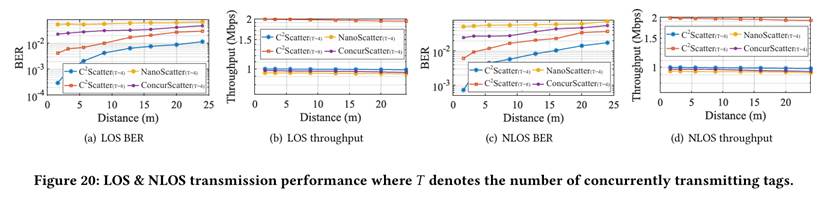
End-to-end tests show much lower BER than NanoScatter and ConcurScatter. With four tags, BER is 75.6 times lower than ConcurScatter and 179.1 times lower than NanoScatter; with eight tags, throughput is about twice as high. C2Scatter maintains BER near 0.02 at 16 m and reaches nearly 1 Mbps at 70 m outdoors with BER below 0.05. Tests with four receiver models, movement, interference, and smart-home sensing also support robustness.
No Q&A
Personal thoughts:
My main takeaway is that C2Scatter is strongest when it treats receiver limitations as a design constraint. I like the pairing of pulling-driven synchronization and delay-domain division: the former reduces tag-side power, while the latter makes commercial Wi-Fi decoding more practical. The prototype and tests across multiple receivers and environments also give the paper’s claims useful credibility.
What I like less is that the “commercial receiver” abstraction still depends on reverse engineering and custom processing, so portability across chipsets is not fully demonstrated. The results also leave open how delay-bin assignment behaves with widely scattered tags, denser traffic, and long-term energy harvesting. Future work could explore adaptive delay-bin scheduling and a fully integrated tag to test whether the projected scalability survives real deployments.