Title: Deep-Soil Acoustic Backscatter Networking for Electrical Substation Grounding Assessment
Authors: Fengrui Zhang, Shanyue Wang, Bowen Xue, Lei Yang (Department of Computing, The Hong Kong Polytechnic University, Hong Kong, China)
Scribe: Xiaoqiang Zheng (Xiamen University)
Introduction:
Electrical substation grounding grids must safely dissipate fault and lightning currents, but their condition changes with soil moisture, temperature, chemistry, and corrosion. Continuous underground monitoring is difficult because radio signals are strongly attenuated in soil, substations create severe electromagnetic interference, and nearby electronics may face kilovolt-level transients. Existing inspection is therefore largely manual.
SoilCapsule proposes a distributed, battery-free acoustic backscatter system for this environment. It harvests ultrasonic energy, measures soil temperature, moisture, and pH, and communicates through ultrasound. Its key insight is to use the buried copper grounding grid as an acoustic waveguide, avoiding both radio interference and inefficient direct surface-to-soil power ing.
Key idea and contribution:
The system has an ultrasonic transmitter coupled to grounding-grid risers, multiple capsule sensors, and an above-ground receiver. Ultrasound travels along the metal grid with much lower attenuation than in soil and radiates mainly at conductor junctions. This grid-to-soil path can deliver energy to deeply buried sensors with far less transmit power than direct surface transmission.
Each sealed capsule harvests energy through a PZT interface, senses the soil, and backscatters data by switching its acoustic reflection. The downlink combines power delivery with pulse-interval encoding, while the bistatic uplink lets a surface receiver directly capture reflections from the sensor. A metal Faraday enclosure, epoxy potting, and sealed outer shell protect the electronics from interference, moisture, corrosion, and high-voltage events.
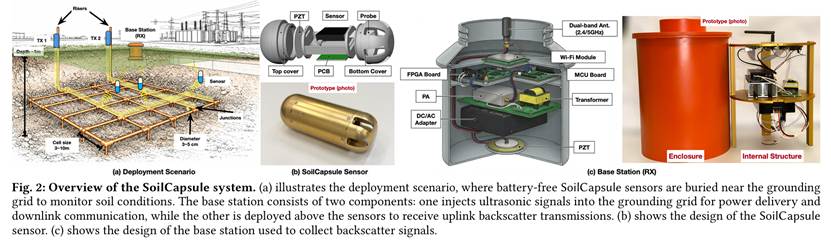
The main contribution is an infrastructure-assisted, battery-free sensing network that combines deep-soil power delivery, acoustic backscatter, and long-term protection. Existing grounding infrastructure becomes both an acoustic waveguide and a platform for continuous soil monitoring.
Evaluation:
The authors use laboratory tests, structural stress tests, and a field deployment. With a 50 W transmitter, grid-to-soil experiments power sensors near 100 cm deep, whereas conventional surface transmission becomes ineffective much sooner. The prototype consumes 23.4 microwatts in receive mode, 156.8 microwatts during backscatter transmission, and 15.3 microwatts in deep sleep.
The dPIE downlink outperforms conventional PIE: its BER falls below 10-4 at about 15 dB SNR and reaches 10-5 at 20 dB. At 1 kbps, the uplink reaches BER below 10-4 near 9 dB SNR. Soil moisture causes only modest SNR changes. Repeated high-voltage impulse tests and accelerated salt-spray aging also show stable communication and only minor sensing degradation.
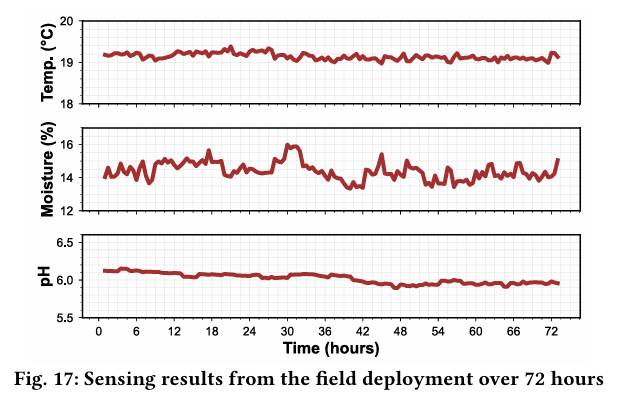
In a working 100 x 100 m2 substation, 20 sensors are buried at 80-90 cm and monitored for one month. A representative 72-hour trace shows stable temperature, natural moisture variation, and small pH drift, demonstrating continuous multi-modal sensing in an operational environment.
Q&A:
Q1: This is an impressive system, and I also appreciate the field testing. What kinds of challenges did you face during the field test, particularly the testing at the actual electrical substation?
A1: We can take that discussion offline. Thank you.
Personal thoughts:
My main takeaway is that SoilCapsule makes unusually good use of infrastructure already present at the deployment site. Treating the grounding grid as an acoustic waveguide addresses the deep-soil power bottleneck, while ultrasound avoids the electromagnetic interference that makes radio sensing unattractive. The battery-free capsule and real substation deployment also make the work feel like a complete engineering system rather than an isolated communication technique.
The main concern is that performance still depends on site-specific grid layouts, soil conditions, and calibration between measured soil properties and actual grounding health. Longer deployments across drier soils, different grid geometries, and varied grounding faults would strengthen the generality claim. An adaptive health-estimation layer using grid topology and multi-sensor measurements would be a promising next step.