Title: EMA: Efficient Model Adaptation for Learning-based Systems
Authors: Daiyang Yu (University of Illinois Urbana-Champaign), Xinyu Chen (University of Illinois Urbana-Champaign), Yihan Zhang (University of Illinois Urbana-Champaign), Yan Liang (The Hong Kong University of Science and Technology), Yaqi Qiao (University of Illinois Urbana-Champaign), Fan Lai (University of Illinois Urbana-Champaign).
Introduction
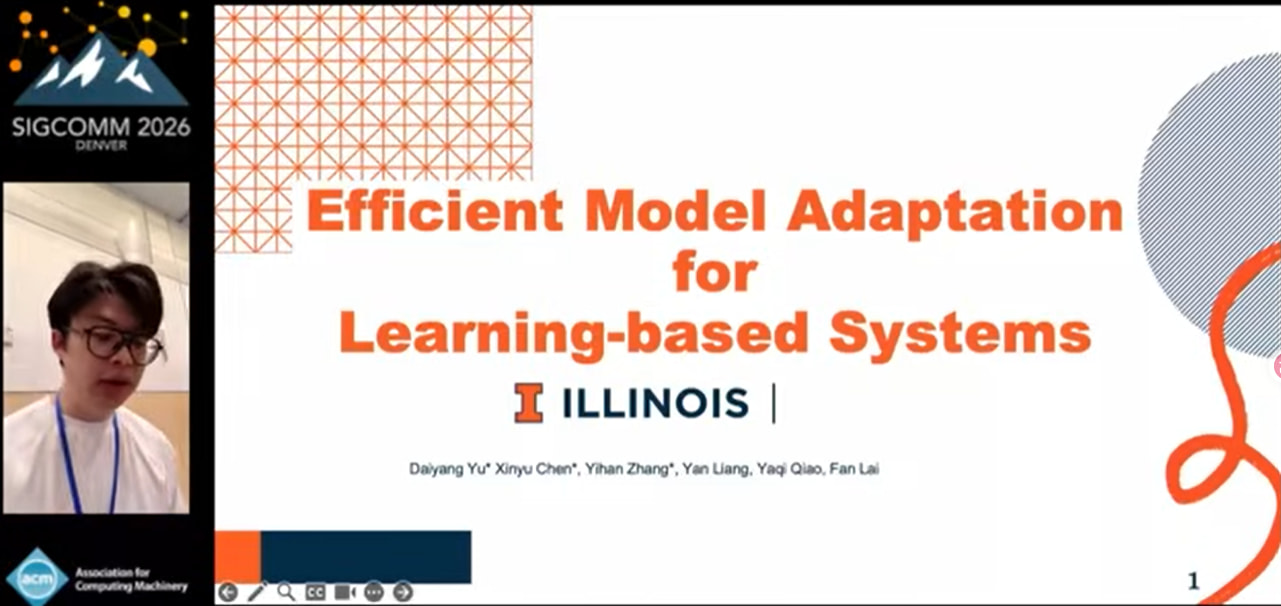
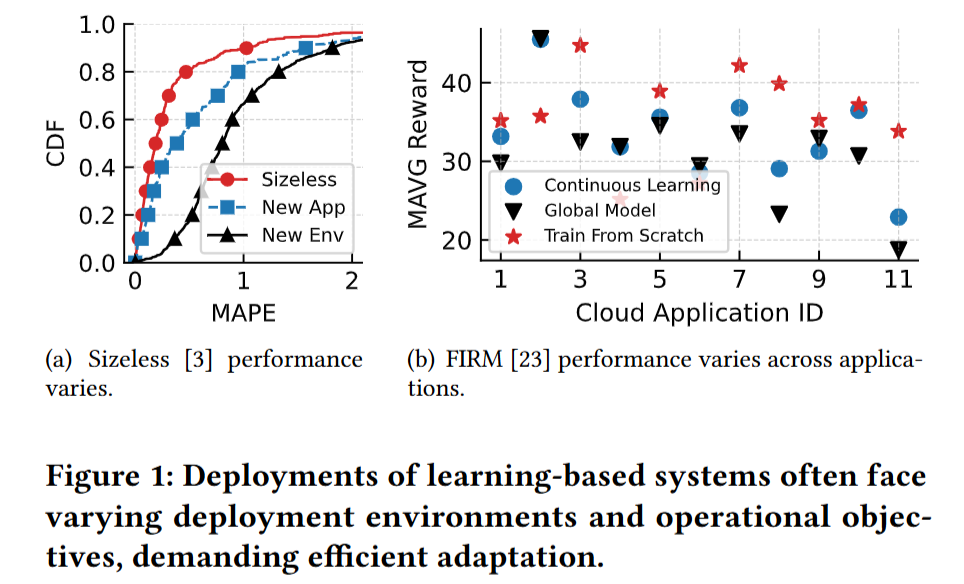
Machine learning (ML) has been increasingly adopted in networked systems and infrastructure management, including traffic engineering, video streaming, resource management, and network simulation. However, unlike traditional ML applications such as image classification, learning-based systems operate in dynamic and heterogeneous environments where workloads, infrastructure, and operational objectives continuously change. These environmental shifts can cause significant performance degradation if models are not adapted properly. Existing learning-based systems often rely on retraining models from scratch or collecting large amounts of environment-specific data, which leads to high computational costs, expensive data labeling, and slow adaptation. Moreover, existing adaptation techniques are usually designed for specific tasks or model architectures, making them difficult to generalize across diverse systems. EMA studies the problem of enabling efficient and general model adaptation for learning-based systems with minimal operational overhead.
Key idea and contribution:

The authors build EMA (Efficient Model Adaptation), a general model adaptation framework that helps learning-based systems quickly adjust to new environments by reusing previously accumulated operational knowledge. The key observation behind EMA is that long-running systems naturally collect historical models, environment states, and operational data. Instead of repeatedly retraining models from scratch, EMA identifies previously encountered environments with similar states and reuses their models and data as a warm start for adaptation.
EMA consists of three main components:
-
State Transformer
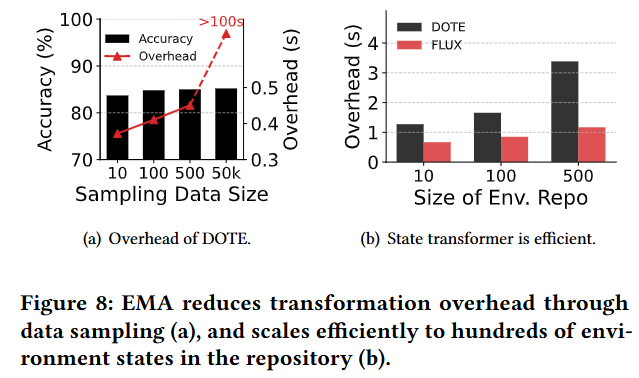
The State Transformer finds a previously deployed environment with a similar state distribution and transforms the new environment’s input state to align with the existing environment. This allows previously trained models to be reused without modifying the original model architecture or system logic. The transformation operates at the input data layer, making EMA applicable to different types of systems and models, including traditional ML models, deep learning models, reinforcement learning systems, and LLM-based systems. -
Labeling Agent
EMA addresses the high cost of collecting training labels by introducing a cost-aware labeling mechanism. Instead of labeling all available data, the Labeling Agent selects samples that are expected to provide the greatest performance improvement relative to their labeling cost. This reduces unnecessary data collection while maintaining adaptation quality. -
Adaptation Orchestrator
The Adaptation Orchestrator coordinates model training and data labeling. It dynamically decides when additional labeling is worthwhile, how much data should be collected, and how adapted models should be stored for future reuse. After adaptation, EMA saves the learned model and environment information into a repository to accelerate future adaptation requests.
The major contributions of EMA are: (1) presenting the first general model adaptation system for diverse learning-based systems; (2) introducing a data-centric approach that reuses operational knowledge while optimizing training and labeling costs; and (3) demonstrating significant improvements through evaluation on multiple real-world learning systems.
Evaluation
The authors evaluate EMA on seven representative learning-based systems from prior SIGCOMM, NSDI, and OSDI research, covering different applications and model types, including flow prediction, WAN traffic engineering, datacenter simulation, resource management, adaptive bitrate streaming, and LLM-based scheduling. The results show that EMA reduces adaptation costs, such as GPU training time, by 14.9%–42.4%, improves adaptation speed by 2.3–15.3×, and increases system performance, such as network throughput and user experience, by 6.9%–31.3%.
This result is significant because modern learning-based systems increasingly operate in changing real-world environments, and the ability to efficiently adapt models without expensive retraining is essential for practical deployment at scale.
Q&A
Q: Okay, we have time for a few questions. I’ll go first. You apply a state transformation, which I think is essentially a lossy operation, right? You are transforming the data from a new distribution back to the original distribution. My question is: do you lose any critical information during this process? Is this similar to performing some kind of dimensionality reduction or compression?
A: I see your point. We did conduct an ablation study to investigate this. After applying the state transformation, we continued training our base model on the transformed data, and we did not observe significant degradation in performance. This suggests that the transformation does not cause substantial information loss, at least for the tasks we evaluated.
Personal thoughts
EMA presents an interesting shift in perspective: instead of treating model adaptation as only a machine learning problem, it treats adaptation as a system-level optimization problem involving computation, data collection, and operational constraints. I like that EMA focuses on practical deployment challenges rather than only improving model accuracy. The idea of maintaining a repository of previous environments and reusing accumulated knowledge is especially valuable because many real-world systems repeatedly encounter similar situations.
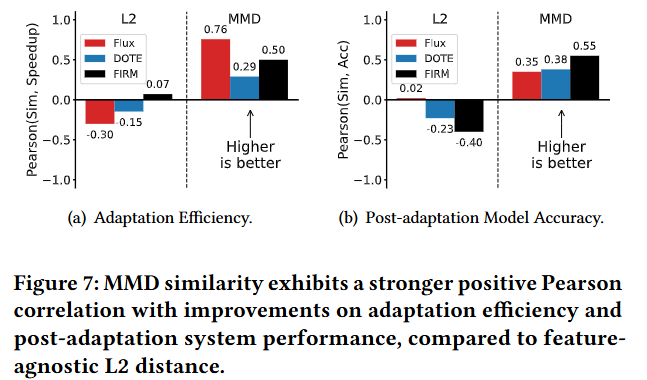
However, EMA also raises several open questions. First, its effectiveness depends on the availability of useful historical environments. If a completely new environment appears without similar states in the repository, adaptation may still require expensive training. Second, although EMA uses distribution similarity metrics to avoid negative transfer, determining whether knowledge from one environment can safely benefit another remains challenging. Future work could explore more intelligent methods for managing large-scale environment repositories, adapting foundation models, and handling highly dynamic systems where environmental changes happen continuously.
Overall, EMA provides a promising direction for future learning-based systems: models should not only learn from data, but also remember and reuse previous experiences to continuously improve adaptation efficiency.