Title: FlowForm: Scalable Passive Metasurface Network for mmWave Coverage Expansion
Authors: Wuqiong Zhao, Baicheng Chen, Kai Zheng, Xingyu Chen, Wenqian Zhang, Xinyu Zhang (University of California San Diego)
Scribe: Xiaoqiang Zheng (Xiamen University)
Introduction:
FlowForm addresses fragile indoor mmWave coverage caused by path loss and blockage. Although mmWave offers multi-gigabit rates, a small movement or obstacle can destroy a link. Active relays and reconfigurable intelligent surfaces (RIS) can adapt beams, but need power, control channels, and runtime coordination. Passive metasurfaces are cheap and easy to deploy, yet fixed patterns make several surfaces difficult to coordinate. FlowForm asks whether a static passive network can expand coverage without modifying standard radios. It combines a major-minor topology, offline placement and beam optimization, low-cost fabrication, and measurements in five indoor environments.
Key idea and contribution:
The central idea is a major-minor flow topology. Major flows use narrow, near-field-focused beams to form a multi-hop relay backbone from the access point through metasurfaces, steering signals around blockages and replacing a long lossy link with shorter hops. Minor flows use wider fan beams from interface surfaces to fill coverage gaps and provide diverse arrival angles. A directional-score analysis compares relaying value with direct coverage and shows that, under an angular-separability condition, optimal power allocation favors relay-facing or receiver-facing directions. This gives the hierarchy a physical and theoretical basis rather than treating it as a heuristic.
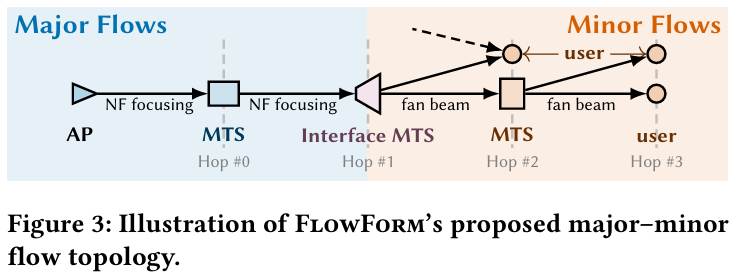
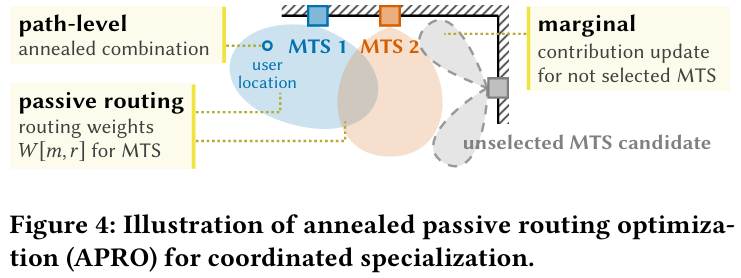
FlowForm reduces the design space by representing each surface with a few beam-arm parameters instead of thousands of unit-cell phases. It plans major paths, optimizes focal distances, selects interface surfaces, and applies annealed passive routing optimization (APRO) to specialize minor surfaces while limiting redundancy. Annealed routing weights gradually move from specialization toward useful cooperation. Final phase refinement accounts for quantization, grating lobes, and fabrication effects. At runtime, static surfaces work with standard 802.11ad/ay beam scanning; diversity scoring improves mobility robustness, and SINR-aware patterns support spatial sharing. This offline-to-runtime separation avoids a new control plane.
Evaluation:
Evaluation uses five indoor scenes from 68.6 to 462.0 m2, 20 cm 80x80 3D-printed panels costing about $2, and an SDR testbed that measures per-beam channel responses, physical rate, and coverage at multiple locations and orientations. Baselines include No MTS, AutoMS+, and FF GrEx; RFMagus+ provides a simulated active-RIS comparison. The setup tests both hardware behavior and end-to-end coverage rather than only simulation.
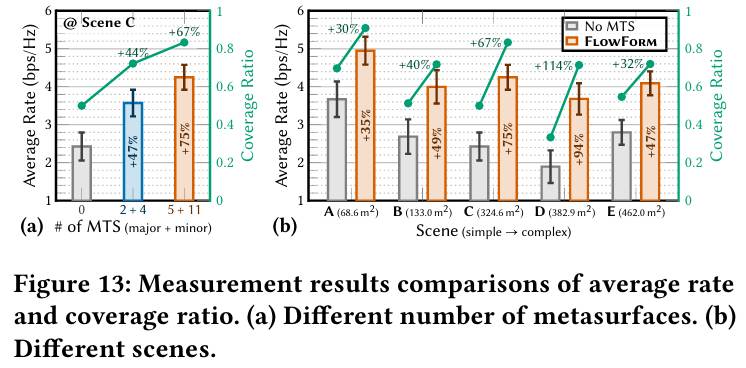
Measured steering is within about 3 degrees of target, the two-arm abstraction works, and correct near-field focusing adds 2.86 dB RSS. In Scene C, 16 surfaces improve average rate by 75% and coverage by 67% over No MTS, outperforming AutoMS+ and FF GrEx; with only 6 surfaces, the gains are already 47% and 44%. In Scene D, gains reach 94% in rate and 114% in coverage. Diverse paths reduce mobility blackouts and permit longer beam-scanning intervals. Compared with realistic-efficiency active RIS, FlowForm uses more surfaces but costs about $32 instead of more than $6,000. The results support the value of coordination, while showing that gains depend on blockage and available mounting surfaces.
Q1:You showed an analysis of the deployment cost. Did you compare FlowForm with the cost of deploying Wi-Fi 7 or Wi-Fi 8 access points?
To clarify, I mean going back to the sub-6 GHz range, such as 5 GHz. A couple of access points might cover the same area, and current Wi-Fi 7 or Wi-Fi 8 systems can also provide gigabit data rates. I would like to understand the motivation for using 60 GHz specifically.
A1:This is a good question. A 60 GHz millimeter-wave Wi-Fi access point typically costs around 200 to 300 US dollars. FlowForm can be cheaper, and it also avoids the need for additional power and backhaul infrastructure.
More generally, 60 GHz and sub-6 GHz Wi-Fi address largely orthogonal problems. The higher frequency offers additional spectrum and opportunities for indoor high-throughput communication, but it also creates a unique coverage problem because of blockage and sensitivity to device orientation. Sub-6 GHz Wi-Fi can provide high data rates as well, but it faces different spectrum and interference constraints.
Therefore, FlowForm is intended to address the coverage and blockage problems that are specific to millimeter-wave communication. It is complementary to, rather than a direct replacement for, sub-6 G Hz access points.
Q2:Could this technology be extended to other millimeter-wave frequencies? I was surprised that you chose 60 GHz, since there are relatively few commercial products supporting it. Could the system be extended to private 5G at 24, 28, or 39 GHz? What would need to change? Would it mainly require changing the optimization problem and using a different frequency?
A2:Extending the system to lower millimeter-wave frequencies is feasible. The physical surfaces would need to be larger, but the optimization problem would remain largely the same. There would be some differences in the coverage objectives. For example, private 5G may target outdoor as well as indoor coverage, whereas this work focuses on indoor environments. Nevertheless, the fundamental coverage and topology problems remain the same.
Personal thoughts:
FlowForm’s main value is its system design. It connects passive hardware limits, multi-hop topology, path diversity, and standard beam scanning into one coherent solution. The offline design is especially appealing: simple surfaces remain unchanged at runtime, while existing radios provide limited adaptation. Measurements and fabrication results make the proposal more convincing than a purely simulated RIS design.
The main weakness is generality. The proof uses a simplified angular model, and the active-RIS comparison is simulated. Open questions include changing buildings, dense multi-user traffic, and the labor of mounting or recalibrating many panels. Uncertainty-aware updates with backup paths could limit redesign to affected surfaces, preserving the low-cost philosophy while improving building-scale practicality.