Title: Inter-domain Routing with Extensible Criteria
Author:
Seyedali Tabaeiaghdaei (Anapaya Systems AG)
Jelte van Bommel (ETH Zürich)
Marc Wyss (ETH Zürich)
João Luis Sobrinho (Instituto de Telecomunicações, Instituto Superior Técnico)
Giovanni Barbiero (UBS AG)
Giacomo Giuliari (Mysten Labs)
Scribe: Mingjun Fang(Xiamen University)
Introduction
The introduction begins by recalling the inherent limitations of BGP, which, despite sustaining global Internet connectivity, fails to offer the flexibility required for today’s diverse operational environments. Different autonomous systems often prioritize different metrics: some prefer low-latency paths, others seek higher bandwidth, and yet others focus on robustness or security. BGP, with its rigid decision process, offers no native means of expressing or enforcing these heterogeneous preferences. This shortcoming limits the ability of operators to optimize their networks and ultimately constrains the performance and resilience of the Internet as a whole. Recognizing this gap, the authors propose an extensible framework that maintains interoperability while enabling richer forms of policy expression.
Key idea and contribution
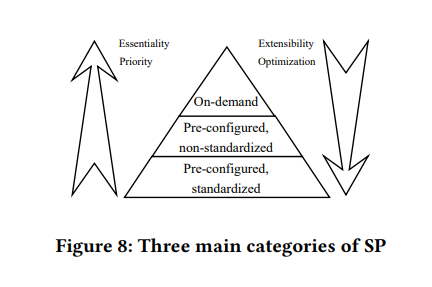
The paper introduces a framework that allows routing decisions to incorporate extensible criteria beyond the fixed rule set of BGP. This is achieved through a generalized interface for criteria, enabling a modular integration of diverse requirements, whether they be latency, bandwidth, security classification, or service-specific goals. The contributions of the paper are threefold: it provides a formal modeling method to ensure that extensibility does not undermine convergence and stability; it defines an extended propagation mechanism that lets autonomous systems express their preferences while safeguarding private policies; and it emphasizes backward compatibility, so that the framework can be incrementally deployed alongside existing BGP systems. Together, these innovations demonstrate a balanced approach that is both theoretically robust and operationally viable.
Evaluation
The evaluation consists of simulations and experiments using real-world Internet topologies to validate both performance and stability. Results show that the proposed framework can significantly increase flexibility in policy expression without sacrificing convergence. In scenarios with multipath redundancy, the extensible criteria enable routing choices that prefer lower-latency or higher-bandwidth paths rather than relying solely on AS path length. Moreover, the incremental deployment analysis shows that the framework retains compatibility: autonomous systems adopting the new mechanism can already benefit from improved routing while remaining interoperable with legacy BGP systems. The findings underscore that the proposal is not merely an academic exercise but a practical advancement in inter-domain routing that can gradually reshape Internet operation.
Q&A
Q1: Is it possible that your work can support the previous work on bandwidth reservation in multipath US routing, maybe by taking bandwidth reservation as a criterion?
A1: Yes, that could be possible. The previous work proposed a control plane using smart contracts, but my work is in-band. However, we can use IRAQ for path exploration, so that we only find paths where all ASes support bandwidth reservation. Otherwise, it would be impossible to guarantee available bandwidth.
Q2: Given that the SCION architecture gives control in the data plane for the sender, would it be possible to decouple the computation from the AS and run it out of band as a separate service? Did you consider that?
A2: The SCION architecture already decouples control plane and data plane, so services run within AS but not on routers. That allows us to use IRAQ. We didn’t consider running it completely out of band, but I’m aware of follow-up projects in that direction.
Q3: If the criteria or preferences change, how do you guarantee routing stability?
A3: That’s the main idea of the paper. Since SCION paths expire automatically (e.g., every 6 hours), new rounds with updated criteria can be started easily, even more frequently if needed. This ensures stability without manual intervention.
Personal thoughts
This paper on IREC is profoundly impressive. It cleverly leverages the stateless forwarding property of the SCION path-aware network to fundamentally address the rigidity of BGP in supporting diverse and extensible routing criteria. This is achieved through the introduction of parallel route computations (Orthogonal RCs) and the on-demand execution of routing programs based on eBPF. Its core idea—liberating routing optimization criteria from rigid standards and transforming them into a “programmable” process that can be defined by end domains in real-time and executed automatically across the network—represents a paradigm shift. It points the way toward building an intelligent Internet control plane that truly adapts to future application demands. Although its large-scale adoption still faces challenges related to ecosystem buy-in and security/trust mechanisms, IREC is undoubtedly a critical step toward infusing Internet routing with much-needed flexibility and adaptability.