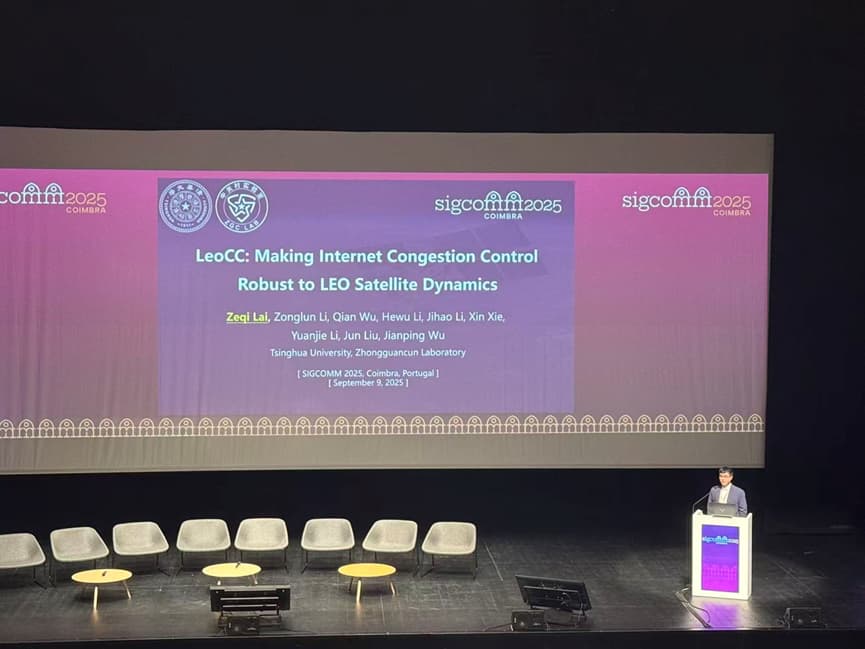
Title: LeoCC: Making Internet Congestion Control Robust to LEO Satellite Dynamics
Scribe : Hongyu Du (Xiamen University)
Authors: Zeqi Lai, Zonglun Li, Qian Wu, HewuLi (Tsinghua University); Jihao Li (Zhongguancun Laboratory); Xin Xie, Yuanjie Li, Jun Liu, Jianping Wu (Tsinghua University)
Introduction
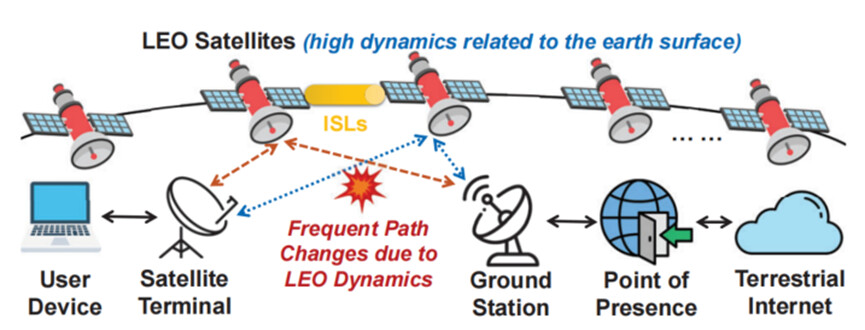
In recent years, low Earth Orbit (LEO) satellite networks (such as Starlink, OneWeb, etc.) have developed rapidly, achieving global broadband coverage and low-latency Internet access through the deployment of large-scale constellations. The traffic it carries continues to grow (for example, Starlink has connected over 5 million users in nearly 100 countries as of January 2025). However, the high-speed movement of LEO satellites relative to the Earth’s surface (approximately 7.8km/s) leads to dynamic changes in network infrastructure, causing frequent and sharp fluctuations in link capacity, latency, and packet loss rate (for instance, capacity can fluctuate between 10 and 70Mbps within tens of seconds, and RTT and the minimum RTT continue to change) The random packet loss rate within the 1-second window reaches 0.5% to 6%. However, the core assumptions of the existing end-to-end congestion control algorithms (CCAs) fail in LEO networks: loss-based algorithms (such as Cubic) cannot distinguish between packet loss caused by dynamics and congestion packet loss, are prone to misjudgment and limit throughput; Delay-based algorithms (such as Copa) overestimate queuing delay due to sharp fluctuations in RTT, resulting in performance degradation. Model-based algorithms (such as BBRv3) rely on the maximum bandwidth and minimum RTT estimation bottlenecks within the historical window, but are difficult to adapt to the rapid changes of LEO networks. Learning-based algorithms (such as VIVACE) are difficult to converge in a timely manner in dynamic environments. These problems make the existing CCAs either have limited throughput and fail to fully utilize the links in LEO networks, or overly occupy the links and cause high latency. There is an urgent need to design new congestion control schemes for the dynamic characteristics of LEO.
Key idea and contribution:
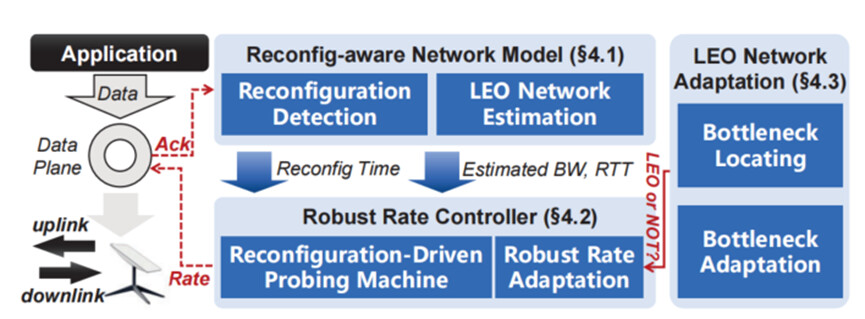
This paper proposes a novel congestion control algorithm (CCA) named LeoCC, aiming to address the challenges posed by the dynamic characteristics of low Earth orbit (LEO) satellite networks to existing congestion control and achieve robustness to LEO dynamics. The core of this solution lies in leveraging the key feature of “connection reconfiguration” in LEO networks - which can implicitly reflect changes in satellite paths and is strongly correlated with network fluctuations. The solution is constructed through three core technologies: Firstly, on the endpoint side, by monitoring the response interval (RI) outliers at the monitoring end, periodic and non-periodic reconfigurations are efficiently detected, and only a single probe flow is maintained to reduce overhead. Secondly, construct a reconfiguration-aware network model, discard the outdated measurement data before the latest reconfiguration, model the LEO path as a series of discrete basic network states, and accurately estimate the network conditions; Finally, a robust rate controller is designed, which includes two core states: dynamic cruise and reconfiguration adaptation. At the same time, a network adapter is integrated to address the dynamic switching of bottlenecks between satellite and non-satellite links. LeoCC has been implemented in the Linux kernel and there is no need to modify the network or application.
Evaluation
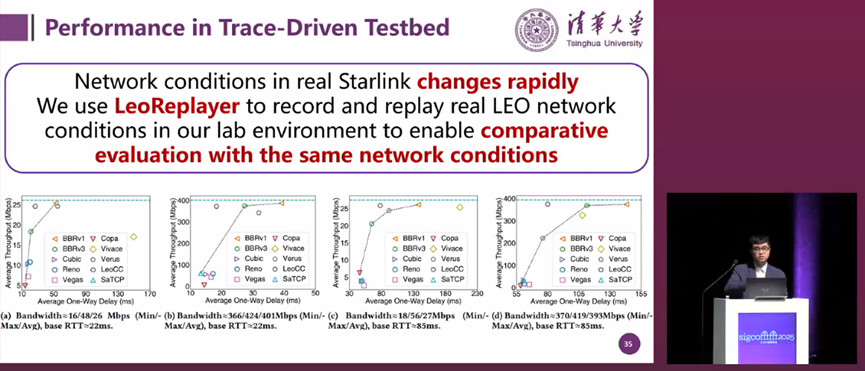
This article is based on a real Starlink network (covering multiple terminals in Madrid, New Jersey, Cebu, etc., and multiple cloud servers in Barcelona, Chicago, etc.) and a controlled environment based on LeoReplayer. LeoCC was compared and evaluated with 11 mainstream CCAs such as Cubic, BBRv1/v3, Copa, and VIVACE. The results showed that: In the uplink, downlink and full-satellite path scenarios of the real Starlink network, LeoCC is located outside the Pareto boundary formed by other CCAs, with a throughput 253% higher than Cubic, 494% higher than Copa and 85% higher than BBRv3. The latency is 44% lower than that of BBRv1 and 56% lower than that of VIVACE, and it maintains the optimal throughput - latency balance under different RTT paths ranging from 52ms to 104ms. In the controlled trace-driven experiment, the link utilization rate of LeoCC reached 95.2% (comparable to BBRv1 and significantly higher than 70.5% of Verus and 81.5% of VIVACE), which can accurately track bandwidth changes and maintain low queuing delay during dynamic bottleneck switching. In terms of fairness, the Jain fairness index of multi-LEOCC streams reaches 0.99-1, and when coexisting with BBRv1, the Jain index reaches 0.98-0.99. Moreover, the detection overhead only accounts for 0.13% of the uplink capacity of Starlink terminals, and the CPU occupancy rate of concurrent streams is only 0.8%-2.2%. At the application layer, the bit rate of LeoCC in DASH video streams is 56%-120% higher than that of Vegas and Cubic, and 14%-27% higher than that of BBRv3. The lag rate is 56%-88% lower than the former and 16%-40% lower than the latter. And it performs stably in scenarios such as bad weather, physical obstructions, and conventional wired networks.
Q&A
Q: Why not use some learning-based methods and then regard the changing state as a condition? This can avoid designing too many heuristic rules.
A: In fact, we did evaluate the results of learning-based algorithms. However, we find that learning content-based control utility functions in the Leo network environment is quite challenging. Due to bandwidth, packet loss and RTT actually fluctuate very greatly. You can read our paper and see the results. We also put them on our Github link.
Personal thoughts
This paper focuses on the key issue of congestion control in low Earth Orbit (LEO) satellite networks. The background analysis is solid. Through measurements of real LEO networks such as Starlink, It clearly reveals the core pain point that the existing congestion control algorithms (CCAs) fail due to their inability to adapt to the sharp fluctuations in link capacity, latency, and packet loss rate caused by the high-speed movement of LEO satellites. The proposed LeoCC scheme is ingeniously designed. It innovatively takes the “connection reconfiguration” feature of LEO networks as the core to construct a reconfiguration-aware network model and a robust rate controller. This solves the problems that existing algorithms have difficulty distinguishing dynamic interference from real congestion and cannot accurately estimate time-varying bottlenecks. Moreover, it does not require modifying the network infrastructure and is highly practical. The experimental evaluation is comprehensive and rigorous. It has been verified from multiple dimensions in a real Starlink network and a controlled environment based on LeoReplayer, fully demonstrating the significant advantages of LeoCC in terms of flux-delay balance, link utilization, fairness, anti-interference capability, and application layer gain. At the same time, the relevant tools and datasets are open-sourced. It provides important support for the research on congestion control in LEO networks. However, the current experiments are mainly based on Starlink residential terminals. The future expansion in other LEO constellations and non-residential scenarios is expected to further enhance the universality of the solution.