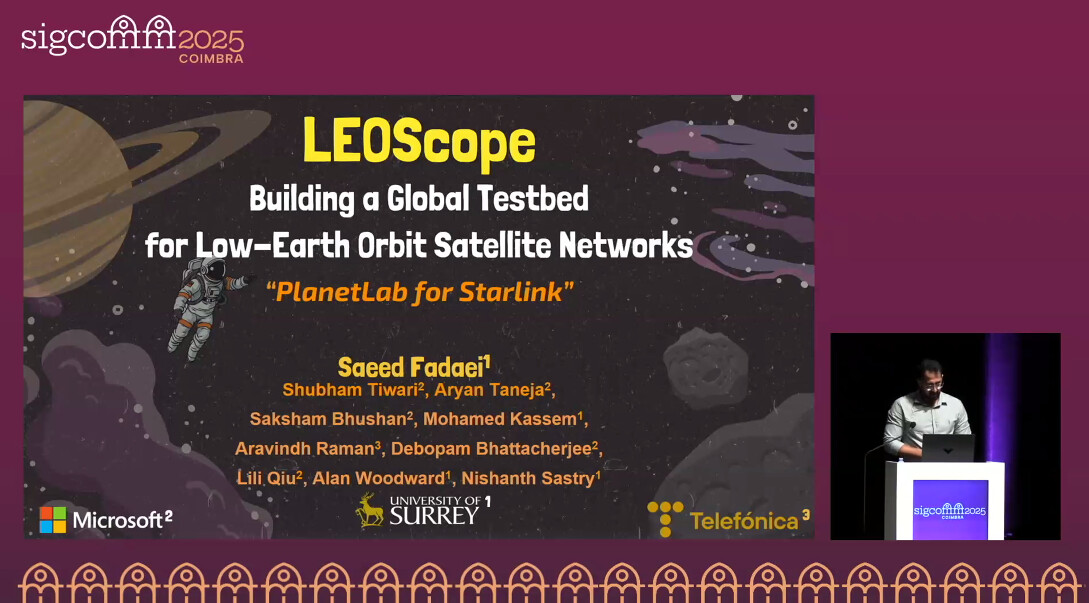
Title: LEOScope: Building a Global Testbed for Low-Earth Orbit Satellite Networks
Authors: Saeed Fadaei (University of Surrey, UK); Shubham Tiwari (Microsoft Research India, University of Washington); Aryan Taneja (Microsoft Research India, UIUC); Saksham Bhushan (Microsoft Research India); Mohamed Kassem (University of Surrey, UK); Aravindh Raman (Cisco ThousandEyes); Debopam Bhattacherjee (Microsoft Research India); Lili Qiu (UT Austin, MSR Asia Shanghai); Alan Woodward, Nishanth Sastry (University of Surrey, UK)
Scribe: Yuntao Zhao (Xiamen University)
Introduction
Low Earth Orbit (LEO) satellite constellations (such as SpaceX’s Starlink) have emerged as a revolutionary means to provide broadband Internet with global coverage and low latency. Unlike terrestrial networks, LEO satellite networks exhibit complex dynamics, including continuously varying propagation delays and frequent satellite handoffs as satellites orbit. While numerous measurement studies have recently examined LEO network performance, each has used isolated approaches – for example, deploying a few nodes in specific regions, repurposing data from public measurement platforms, or using simulations. These point solutions face limitations in reproducibility, completeness, or realism. To address these challenges, this paper introduces LEOScope, a globally distributed testbed designed specifically to measure and analyze LEO satellite networks. LEOScope aims to quantify performance opportunities and bottlenecks of LEO networks and to be made available to the community for broad use.
Key Idea and Contribution
- Globally Distributed Testbed: LEOScope is built as a worldwide platform of volunteer nodes that can run network experiments in a containerized fashion. The testbed runs experiments as Docker containers, meaning any functionality that can be packaged into a container can be deployed on LEO nodes. This design makes it easy for a variety of nodes (in volunteers’ homes or in labs across different countries) to join, regardless of hardware, and allows researchers to push out custom measurements with minimal friction.
- Event-Driven Trigger Mechanism: To cope with the highly dynamic nature of LEO networks, LEOScope incorporates an event-based trigger system for scheduling experiments. Researchers can specify conditions under which measurements should automatically run – for instance, if a certain network condition is detected (e.g. a latency spike or throughput drop) or if an external event occurs (e.g. heavy rain, solar storms). This “if-this-then-that” style trigger mode enables proactive capture of transient phenomena that might otherwise be missed. The platform also supports scheduling regular measurements (similar to cron jobs) to ensure baseline performance data is collected alongside event-triggered tests.
- Volunteer-Centric Safeguards: Recognizing that the testbed relies on contributors’ internet connections, LEOScope is engineered with multiple safeguards to avoid abusing or disrupting volunteer nodes. Technically, a “scavenger mode” was implemented as a primary protective measure: the system continuously monitors a volunteer’s own traffic and defers scheduled experiments if the user is actively using their network, thereby preventing interference with the volunteer’s normal internet usage. Additionally, strict network isolation and least-privilege principles are applied to the Docker containers to ensure that experiments cannot harm the host system or snoop on local network data. On the policy side, experimenters must provide proof of ethical approval (or pass a checklist asserting the experiment is harmless) and sign an end-user license agreement (EULA) before deploying tests. These combined measures foster a culture of responsible research and lower the barrier for people to safely contribute nodes.
- Demonstration and Open Access: To showcase LEOScope’s capabilities, the paper presents initial measurement results of Starlink’s network performance collected via the testbed. Using volunteer nodes across multiple countries, the authors measured metrics like latency and throughput on Starlink. The results highlighted clear geographic differences in round-trip latency distributions, and captured the impact of environmental events on performance – for example, during a geomagnetic storm (aurora) event, a node in Edinburgh saw a significant throughput drop on Starlink, and similarly heavy rain caused noticeable throughput degradation compared to clear weather. These case studies demonstrate that LEOScope can effectively capture phenomena unique to LEO networks. The authors have also provided details on how to use the testbed and made a live dashboard available, essentially inviting the community to contribute nodes and experiments to scale up LEOScope’s reach.
Evaluation
The initial use of LEOScope confirms its effectiveness and utility for LEO network measurement.
- Capturing Performance Variability: Measurements show that Starlink’s network performance varies substantially across locations and conditions. For instance, the distribution of latency (RTT) differs between distant regions like California and Abuja, Nigeria, indicating that any network optimizations for LEO’s varying delay should be tested over a wide geographic span.
- Measuring Environmental Effects: Leveraging its trigger-based design, LEOScope managed to record short-lived events that impact performance. The results demonstrated that during intense solar activity (geomagnetic storm), Starlink downlink throughput at some northern locations dropped significantly; likewise, heavy rainfall led to lower throughput compared to clear or moderate weather conditions. These findings align with prior work that inferred weather impacts on LEO performance (e.g., increased latency during rain), but here LEOScope was able to proactively gather high-resolution data during the events, improving confidence and detail in the observations.
- Overhead and Reliability: The paper also discusses the practicality of deploying and running LEOScope nodes. Thanks to containerization and the resource-aware scheduling, the additional load on a volunteer’s network is kept within reasonable bounds, and a cloud dashboard monitors node status and experiment execution in real time. Overall, the evaluation demonstrates that LEOScope provides an effective way to continuously and globally monitor LEO satellite network behavior, offering researchers a novel, fine-grained view into these networks that was not previously possible.
Personal Thoughts
LEOScope represents a significant and timely step forward in our ability to study LEO satellite internet in the wild. By creating a “PlanetLab for LEO broadband,” the authors have lowered the barrier to entry for comprehensive LEO measurements through careful design choices that account for the network’s dynamics and the realities of volunteer participation. In my view, this platform will greatly accelerate LEO networking research, enabling experiments and data collection at a scale and diversity that individual efforts could not easily achieve. Of course, scaling up such a global testbed comes with challenges: attracting and retaining volunteer nodes, managing costs and maintenance, and ensuring fair use and security as the reviewer feedback highlighted. Addressing these will be key to the long-term sustainability of the project. Nonetheless, the introduction of LEOScope is a pivotal development – it unifies previously fragmented measurement endeavors into a cohesive infrastructure tailored for satellites. I anticipate that this work will spark considerable interest in the community and lead to many new insights as LEOScope grows, ultimately helping to optimize and innovate within the burgeoning realm of LEO satellite networks.