Title: Making Cellular Networks More Efficient By Roaming-in-Place
Author: Tenzin Samten Ukyab (UC Berkeley), Lisa Suzuki (Waseda University), Demetrius Davis (Virginia Tech), Zhihong Luo, Silvery Fu (UC Berkeley), Shaddi Hasan (Virginia Tech), Sylvia Ratnasamy (UC Berkeley), Scott Shenker (UC Berkeley & ICSI)
Scribe: Gao Han (Xiamen University)

Introduction
This paper studies the problem of improving efficiency in cellular networks through more flexible use of roaming. Traditional roaming allows users of operator A to connect to operator B’s infrastructure, but only when A lacks coverage. This paper proposes a generalization called Roaming-in-Place (RinP), where users can be redirected to towers of other operators even in areas with overlapping coverage. This approach can help operators more efficiently scale capacity in dense, high-demand areas and improve availability and tail performance for users.
Key Idea and Contribution
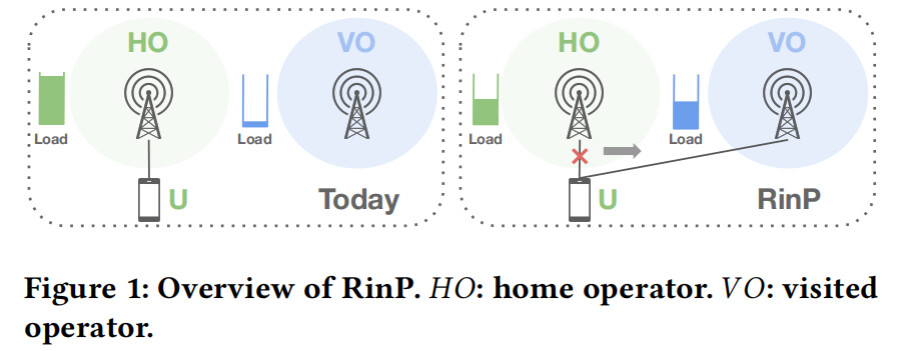
The paper proposes RinP, a lightweight, operator-driven mechanism that reuses roaming mechanisms and introduces two main components to enable fine-grained, on-demand cross-operator offload:
-
A readiness service where operators expose per-region tower readiness (capacity/acceptance) to pre-approved roaming partners via an over-the-top API.
-
A roamover procedure that reorders a UE’s equivalent-PLMN (EPLMN) preference, triggers detach/reattach (or uses the S10/N14 inter-core handover optimization) so that the UE reattaches to the selected visited operator.
The readiness service lets towers query partner readiness and reserve capacity before offloading, while the roamover leverages existing 3GPP hooks (EPLMN reordering + standard detach/attach), so the mechanism is largely a policy/configuration shift rather than a standards change.
Evaluation
The paper evaluates the RinP solution from three perspectives: (i) system overheads of roamovers, (ii) network efficiency benefits, and (iii) user performance benefits. The results show that an operator-centric, standards-compatible extension of existing roaming practices can materially improve infrastructure efficiency (≈30–40% savings in the evaluated scenarios) and user tail performance while requiring only modest implementation changes (small LoC additions, optional S10/N14 support, and simple UE/baseband optimizations).
Question
Q1: You mentioned that your solution does not require changes to standards. But what about accounting? For deployment, operators need agreements and charging mechanisms. How would that work?
A1: Since our solution reuses existing roaming mechanisms, we can also reuse today’s accounting and settlement systems. Operators are already interconnected through the IPX network for roaming settlements, and RinP can leverage the same infrastructure without requiring new mechanisms.
Q2: You mentioned that caching can match handover latency, but in a multi-user shared environment, is continuous caching actually feasible?
A2: The caching to support fast handover can actually be done on the user device. Modern smartphones already support such caching mechanisms during re-attachment, though they are not normally enabled.
Personal Thoughts
RinP reuses existing roaming mechanics and focuses on operator-driven, policy-controlled offload rather than proposing a sweeping standards rewrite. That makes the proposal both technically feasible and operationally realistic. The readiness service and roamover mechanism are simple yet powerful ideas.