Title: RANBooster: Democratizing advanced cellular connectivity through fronthaul middleboxes
Scribe : Hongyu Du (Xiamen University)
Authors: Xenofon Foukas (Microsoft); Tenzin Samten Ukyab (UC Berkeley); Bozidar Radunovic (Microsoft); Sylvia Ratnasamy (UC Berkeley); Scott Shenker (ICSI & UC Berkeley)
Introduction
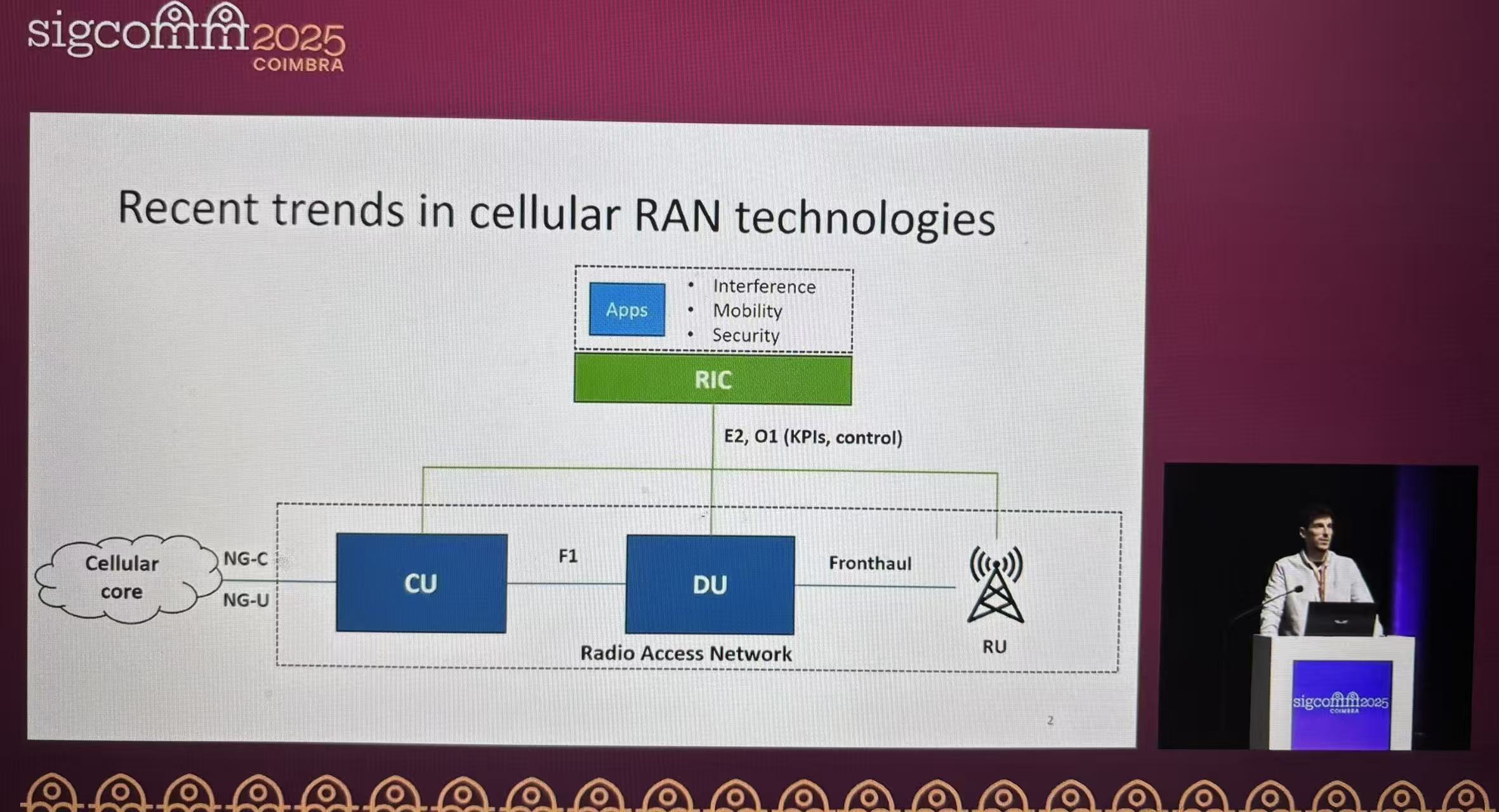
5G radio access network (RAN) is moving towards virtualization and decoupling, aiming to reduce costs and drive innovation by promoting vendor interoperability and expanding the ecosystem. Against this backdrop, small RAN vendors and open-source projects have emerged, focusing on low-cost modular architectures, but they face two key challenges: First, it is difficult to achieve top-notch performance. Advanced functions such as interference mitigation and RU sharing required by enterprises and telecommunications networks are mostly integrated into the solutions of mainstream vendors. Small vendors lack resources for development and thus have insufficient competitiveness. Second, there is a lack of data and control permission access. Mainstream vendors do not fully adhere to open standards and interfaces, making it difficult for third-party developers to obtain full permissions to implement advanced functions, resulting in vendor lock-in. To address these issues without modifying the existing RAN network functions and maintaining compatibility with multi-vendor devices, the research team proposed a RANBooster architecture based on fronthaul middleware.
Key idea and contribution :
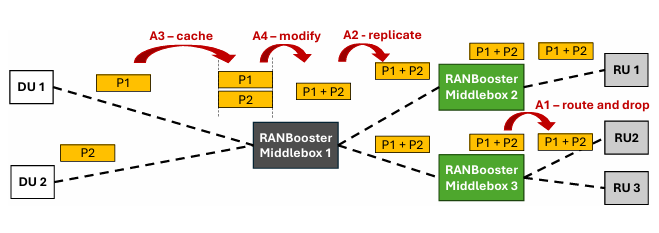
The solution proposed in this paper is named RANBooster. This architecture is deployed in the 5G RAN fronthaul network connecting RU and DU, aiming to solve the performance bottlenecks and permission access problems faced by small vendors and Open source projects in the Open RAN ecosystem. It relies on a standardized and open fronthaul interface (Ethernet foundation, carrying UE control and data information, with concise semantics and easy interoperability), without modifying the existing RAN network functions. It supports third parties to dynamically develop and deploy independent RAN applications in the form of middleware. The core supports four processing actions: packet redirection and discarding, replication, caching, and payload inspection and modification. It also provides template-based design and API libraries to simplify development, and can achieve efficient deployment and chain combination with the help of technologies such as DPDK, XDP, and SR-IOV. To verify the solution, the research team constructed four reference applications: Distributed Antenna System (DAS), distributed MIMO (dMIMO), RU sharing, and real-time PRB monitoring. Evaluated on an enterprise-level 5G testbed covering multiple floors, multiple Foxconn RU and srsRAN, CapGemini, Radisys three RAN stacks Verify the correctness of the application (such as DAS expansion coverage and throughput compliance, dMIMO performance consistent with single RU MIMO), interoperability (no need to modify code for multi-RAN stack reuse), and cost advantages (41% reduction in deployment cost compared to traditional DAS), while enhancing the flexibility of network upgrades (such as multiple operators sharing infrastructure and switching middleware to improve performance). Help break the monopoly of manufacturers, promote Open RAN innovation and the commercialization of RAN deployment.
Evaluation
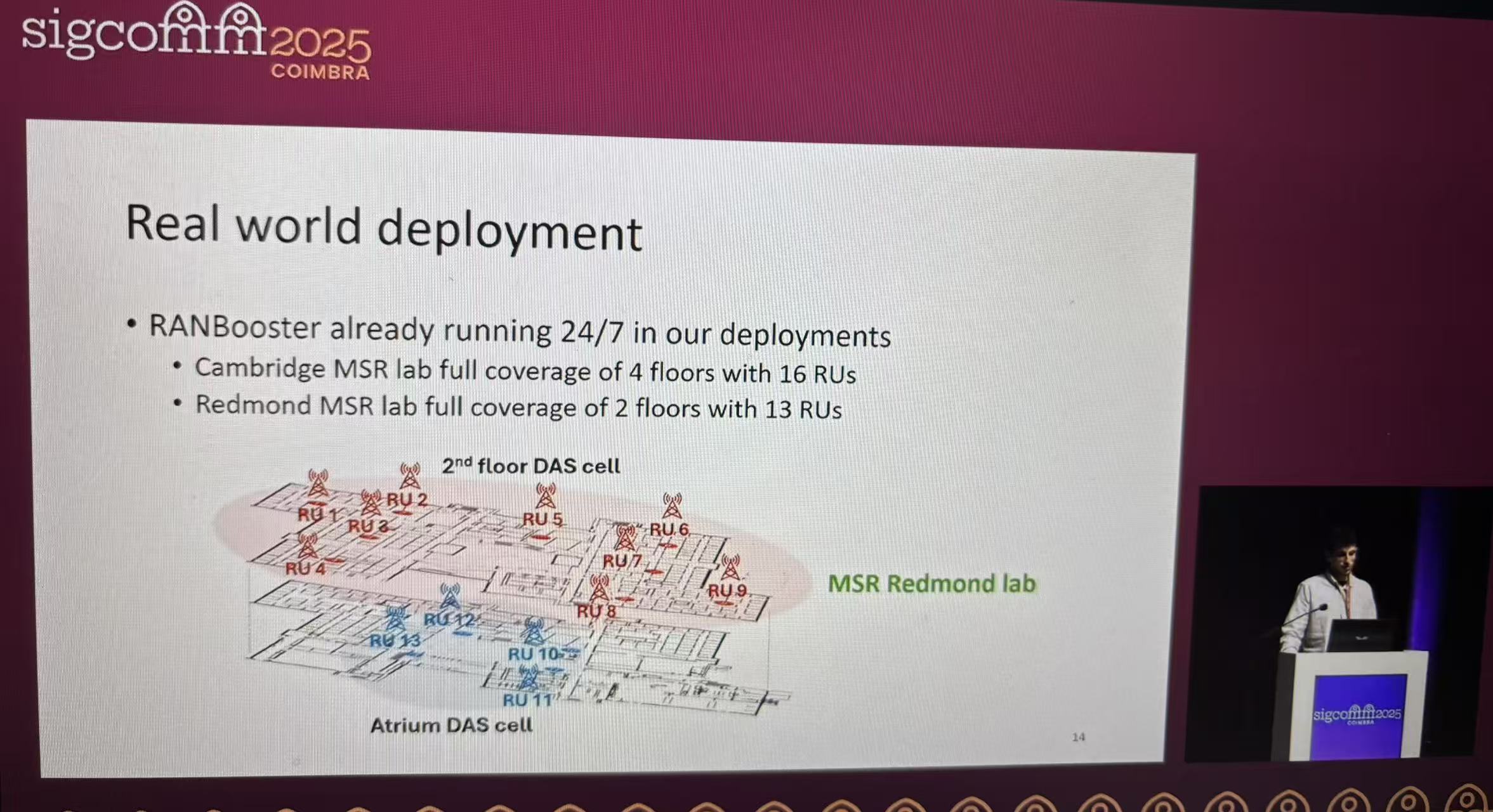
The experimental evaluation of RANBooster on the enterprise-level 5G testbeds (covering five floors of the Cambridge campus of Microsoft Research UK, multiple Foxconn O-RAN RU and three RAN architectures of srsRAN, CapGemini, and Radisys) shows that its four reference applications are all correct and effective: The DAS middleware can extend the signal of a single cell to five floors, allowing all ues to access normally and maintaining the same throughput as the baseline of a single RU. The dMIMO middleware builds a virtual RU by combining ordinary RU. When achieving Layer 2 and Layer 4 MIMO, the throughput is comparable to that of a single RU MIMO benchmark, and the UE rank indicator meets expectations. The RU sharing middleware supports two 40MHz DUs sharing 100MHz RU, and the throughput is consistent with the baseline of the dedicated 40MHz RU. The PRB utilization rate estimated by the real-time PRB monitoring middleware based on the BFP index is highly consistent with the actual value of the RAN stack MAC scheduling log. Meanwhile, this solution demonstrates multiple advantages: In terms of ease of use, the DAS middleware, which only requires basic orchestration knowledge for deployment, enables the UE to achieve approximately 700Mbps throughput across the entire floor, outperforming traditional multi-cell deployment. In terms of flexible upgrades, through the chain combination of middleware, it is possible to achieve multi-operator shared infrastructure, replace middleware to enhance performance (dMIMO’s throughput is 2-3 times higher than that of DAS), and reduce server power consumption by 41% in single-cell deployment. In terms of performance, the DAS middleware implemented by DPDK can support four rus without packet loss on a single CPU core. Adding more CPU cores can further expand it. The XDP implementation is more suitable for CPU-constrained scenarios. Moreover, all middleware can be reused without code modification under different RAN architectures, verifying its interoperability and practicality. In terms of cost, The deployment based on RANBooster reduces the cost by 41% compared to the traditional DAS solution (approximately $60,000 for the Cambridge deployment vs. $154,000 for the traditional one).
Q&A
Q : You mentioned earlier that the delay caused by the middle box might be a problem, but you didn’t mention whether it exists and why it doesn’t, did you?
A : For the middle box we present here, we have presented several benchmarks in the paper. The latency is actually very low because the actions you take mainly focus on modifying certain fields of the header. Therefore, this not only enables us to build these and expand them to up to 8, but also 9 radios serve as our reference implementation. But it also allows us to change the several boxes in the middle together. For instance, in the paper, we demonstrated how to use, for example, several distributed my mobile boxes, deploy them respectively on different floors, and then combine them with the Das system to cover the entire building. Latency is still not an issue because the processing time you need is in the microsecond range.
Personal thoughts
This paper takes the performance and permission predicaments faced by small vendors under the trend of 5G RAN virtualization and decoupling as the entry point, and innovatively proposes the RANBooster architecture based on fronthaul middleware. Its core value lies in leveraging standardized open fronthaul interfaces and general network technologies to achieve this without altering the existing RAN functions Through modular middleware design and rich data packet processing capabilities, it provides flexible and low-cost solutions for third parties to develop and deploy advanced RAN applications. The paper, through the design of four major reference applications and verification on the enterprise-level testbed, fully confirms the advantages of the solution in terms of performance, interoperability and ease of use. It can not only help small manufacturers break through technical and cost barriers and promote innovation in the Open RAN ecosystem, but also bring significant reduction in CAPEX and improvement in network upgrade flexibility to operators. At the same time, its template-based development model and scalable middleware chain deployment capability also provide a clear and feasible technical path for the future iteration of RAN functions and the expansion of new scenarios (such as sensing and security enhancement), which is of great significance for breaking the monopoly of traditional RAN vendors and accelerating the popularization of 5G and subsequent network technologies.