Title: Research Community and Action in a Time of Upheaval
Host: Jim Kurose (University of Massachusetts)
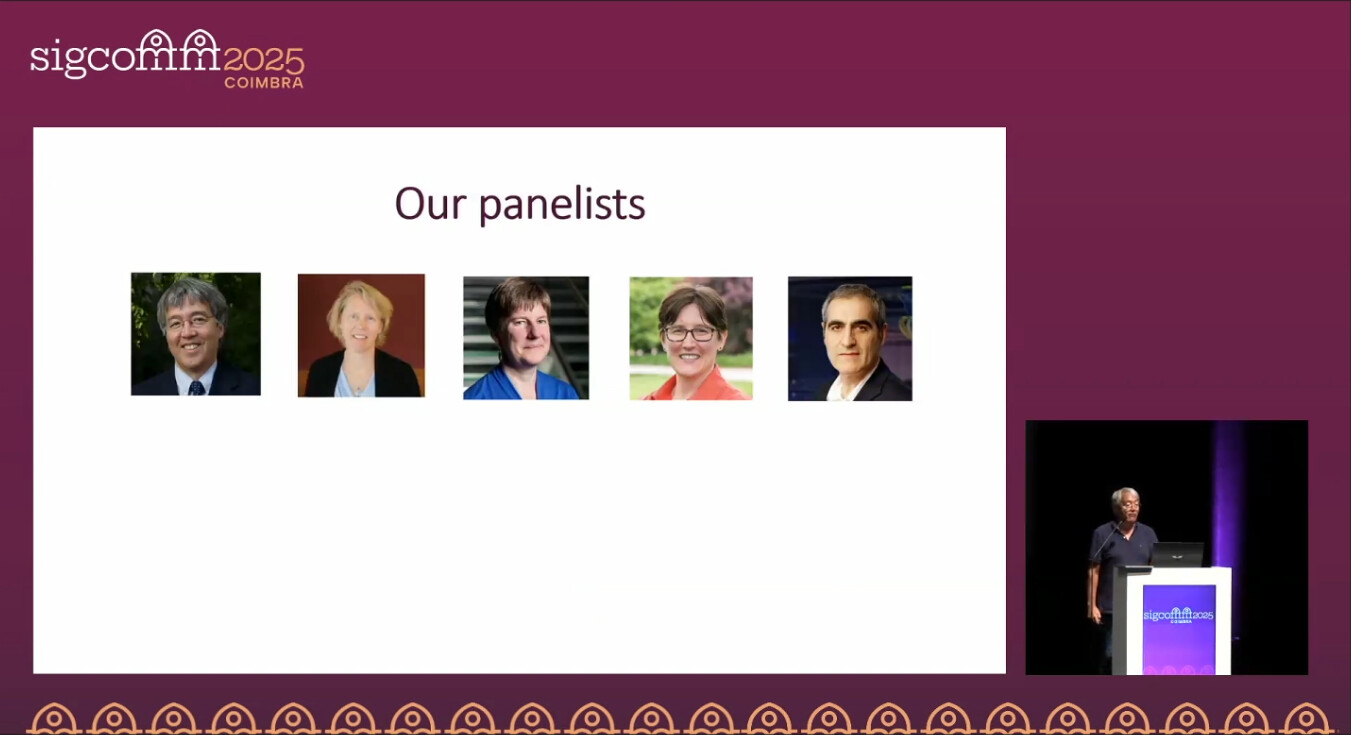
Panelists: Tracy Camp (Executive Director and CEO, Computing Research Association), Serge Fdida (Professor, Sorbonne U), Jennifer Rexford(Provost and Professor, Princeton University), and Ellen Zegura (Acting Assistant Director for the US National Science Foundation Directorate of Computer and Information Science and Engineering and Professor, Georgia Inst. Tech.)
Scribe: Letian Zhu (Xiamen University)

Introduction
It is a time of unprecedented upheaval in the U.S. science and engineering research community, with global consequences for our field. Federal science agencies face budget and programmatic cuts, and the disbanding of community advisory committees; international students and researchers face a myriad of visa concerns; and the narratives surrounding the very value of federally funded fundamental research are being questioned. Our institutions and research community are imperiled.
This session provides a moderated forum (with panelists, followed by an open discussion) for the SIGCOMM community to brainstorm both individual and community actions. It is not a venue for “venting” or partisan politics, but a place for emphasizing community, a sense of belonging, and strategizing actions to help each other and strengthen our entire research enterprise.
Questions and Opinions (Based on your recording)
- Key Questions Explored:
- What are the threats facing the research community (budget cuts, advisory disbandment, visa issues, and diminishing narratives around the value of federally funded research)?
- How can individuals and the community collectively respond to preserve, reshape, and evolve key institutional and community aspects?
- Panelist Perspectives:
- Tracy Camp emphasized CRA’s advocacy role—engagement with policymakers, visibility, and strategic collective action.
- Jennifer Rexford underlined institutional resilience through communication, flexibility in supporting early-career researchers during disruption, and maintaining academic excellence and freedom.
- Serge Fdida offered an international dimension: academic freedom, solidarity, and deeper societal dialogue, especially on emerging topics like AI.
- Ellen Zegura stressed the need for belonging and community in turbulent times and practical strategies to reinforce collective identity and mutual support as foundations for resilience.
Discussion
Q1: How should the community improve public communication about research value?
- Panelists emphasized the need for better public outreach demonstrating how federally funded research creates everyday benefits (e.g., smartphone glass technology)
- Broader impacts, including economic development, education, and AI literacy, should receive equal emphasis with intellectual merit
- The community must create videos, editorials, and other accessible content showing the research’s societal value
Q2: What role can international networks play in supporting at-risk researchers?
- Audience highlighted organizations like CARA (Council for At-Risk Academics) in the UK that relocate displaced researchers
- The European “Stand Up for Science” movement emerged to support U.S. scientists
- Panelists agreed that the crisis requires global cooperation and transcends national boundaries
Q3: How can the community adapt communication strategies for policymakers?
- Paul Barford noted the need to speak policymakers’ language, emphasizing economic development and opportunity rather than traditional academic discourse
- Ellen Zegura stressed connecting broader impacts with societal needs, particularly workforce development and education
- Economic development arguments resonate across political divides more effectively than purely intellectual merit arguments
Q4: What specific actions can individuals and institutions take?
- Engage with CRA’s Community Action Plan and congressional advocacy efforts
- Contact legislators regardless of political affiliation to emphasize research importance
- Universities should support openness, international collaboration, and academic freedom
- Develop creative funding diversification strategies, including industry partnerships
Personal Thoughts
This session underscored that community solidarity is as vital as funding in safeguarding research. I was struck by Tracy Camp’s call for “hyper-engagement,” which reframes crisis as a chance for collective advocacy. Rexford’s focus on protecting graduate students and junior faculty highlighted the human dimension, reminding us that resilience is about people as much as systems. Serge Fdida’s international perspective made it clear that these challenges transcend borders and demand global cooperation. Overall, the discussion convinced me that the future of research depends not only on resisting cuts, but on rethinking how we engage with society, communicate our value, and support one another.