title:Rethinking Cloud Optimization: Volatility-Driven for Better Outcomes
Authors: Baoqing Wang, Gongming Zhao, Hongli Xu, Shibo Wu, Zhuolong Yu, Jiawei Liu, Junhong Lu (University of Science and Technology of China; Suzhou Institute for Advanced Research, University of Science and Technology of China); Shaohui Xu, Fanjie Meng (Tencent Cloud)
Scribe : Mengqi Fu (Xiamen University)
Introduction
Cloud providers commonly rely on oversubscription to reuse resources requested but not actually consumed by tenants. However, resource usage fluctuates over time, and nodes can still become overloaded during occasional demand peaks. Existing approaches typically migrate or reschedule workloads after overload occurs, introducing response delay and scheduling overhead; another class of approaches reserves resources conservatively according to historical peaks, reducing the room for oversubscription. The paper moves the problem one step earlier: although the volatility of an individual workload may be difficult to control, combining workloads with staggered peaks and valleys can flatten their aggregate demand curve and expand the safe operating region for oversubscription.
Key Idea and Contributions
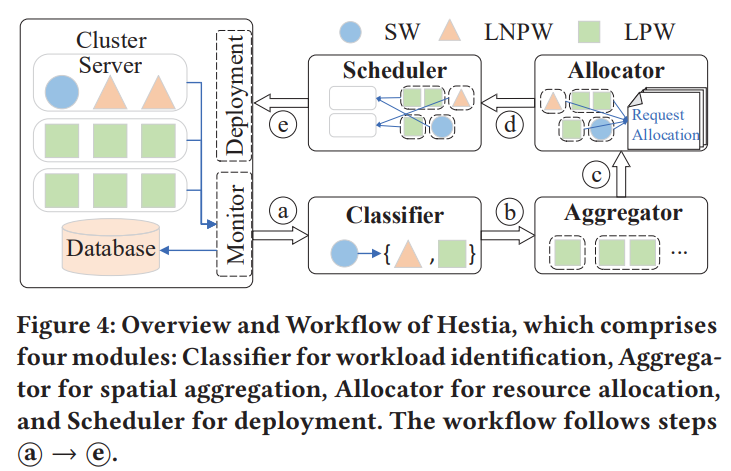
Hestia’s central idea is to identify long-running periodic workloads whose future behavior is predictable, aggregate workloads with complementary peaks and valleys into groups, and perform SLA-aware oversubscription at the group level. The complete system forms a four-stage loop of classification, aggregation, allocation, and scheduling (Figure 4).
-
A peak-oriented volatility metric, MCV. The conventional coefficient of variation (CV) divides the standard deviation by the mean and characterizes fluctuation relative to the mean. Oversubscription safety, however, is determined by peak demand. The Maximum-based Coefficient of Variation (MCV) instead measures the normalized distance from each observation to the maximum. The paper proves a tight linear relationship between MCV and resource utilization: for a fixed peak capacity, a smaller MCV corresponds to higher average utilization.
-
A Classifier that identifies long-running periodic workloads suitable for safe aggregation. The system first smooths each resource-usage series with LOESS and then computes a Periodicity Confidence Score (PCS) from the similarity of multiple windows within a candidate period. Only sufficiently long-running workloads with persistent periodicity, or LPWs, enter the aggregation pool; non-periodic workloads remain under conventional management. An overload or SLA violation triggers demotion, while promotion requires two consecutive periodicity detections, preventing frequent state oscillation.
-
DWA for combining complementary workloads under capacity constraints. Density-based Workload Aggregation (DWA) treats node capacity as a hard constraint that cannot be exceeded at any point in time. It rapidly constructs complementary groups through density ordering and greedy matching, with the objective of minimizing total MCV across all workload groups. When more offline control-plane budget is available, Local Search Refinement (LSR) can further reduce MCV through local exchanges. DWA captures most of the benefit, while LSR provides incremental refinement, allowing the approach to scale to hundreds of thousands or even millions of workloads.
-
An SLA-aware Allocator that balances profit and violation risk. The Allocator uses a lightweight feed-forward neural network to predict a safe resource allocation for each aggregated group. Its asymmetric loss penalizes peak underestimation more heavily because underestimation incurs SLA service credits, whereas overestimation mainly sacrifices part of the oversubscription profit. Rather than optimizing utilization alone, the allocator directly optimizes net profit—resource gains minus service credits. Finally, the Scheduler treats each aggregated group as the basic deployment unit and places groups onto cluster nodes using conventional load balancing.
-
An end-to-end framework transferable across resource types. Hestia’s core inputs are only resource-usage time series and node-capacity constraints. Its MCV metric, predictability-based filtering, capacity-feasible aggregation, and risk-aware allocation therefore apply not only to CPU but also to memory, disk I/O, and network bandwidth, with resource-specific risk and constraint models added as needed.
Evaluation
The evaluation consists of component-level microbenchmarks and end-to-end experiments. The component experiments use Alibaba-trace-v2018, containing more than 70,000 workloads, and Alibaba-trace-v2022, containing more than 470,000 workloads. The end-to-end evaluation uses Tencent-trace-v2025, which covers approximately 1.07 million workloads from 61 production clusters and 14 days of CPU data. Experiments run on a 24-server Kubernetes cluster: 20 servers host workloads, two execute Hestia’s control and analysis logic, and two form an elastic resource pool.
-
The Classifier balances coverage, risk, and profit. The paper sets the PCS threshold to 0.4. At this threshold, the Classifier identifies 37.4% of workloads as periodic, with a subsequent SLA violation rate of 9.7%. In comparison, FFT covers 61.4% but incurs a 72.1% violation rate. Harmonic Regression has a violation rate of only 1.1% but identifies just 1.7% of workloads and is therefore overly conservative. K-Means covers 29.2% with a 14.9% violation rate. For 50,000 workloads, Hestia’s Classifier completes in 9.7 s, approximately 4.7× faster than K-Means at 45.8 s and 3.7× faster than Lomb–Scargle at 36.3 s.
-
The Aggregator reduces volatility. DWA processes 50,000 workloads in only 2.8 s. At the same scale, CompVM, LB-Peak, Optum, and LB-Volume require 5.8 s, 22.1 s, 35.9 s, and 259.5 s, respectively, making DWA up to 92.7× faster. The raw workloads have an average CPU MCV of 0.817, which falls to 0.463 after DWA aggregation—a 43.3% reduction. The strongest baseline, CompVM, reaches 0.510, so DWA provides a further improvement of roughly 9%–10%. For 10,000 LPWs, the aggregated MCV is 0.456 in the first half of the trace and 0.454 in the second, a difference of only 0.002.
-
The Allocator is safer than historical-peak methods. As the history/future split ratio varies from 0.10 to 0.50, the Allocator’s violation rate remains below 1%, showing little sensitivity to the history window. N-sigma still incurs violation rates of approximately 15%–23%, while Resource Central-like performs worse. Across the two settings, the Allocator places 86.8% and 100% of workloads in the safe tier with availability above 99.975%, compared with only 70.9% and 56.8% for Crane.
-
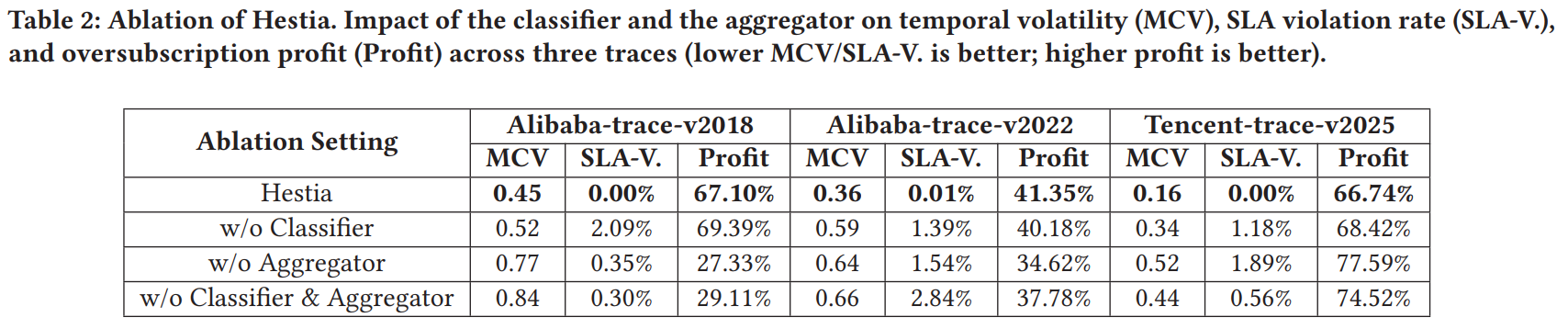
Ablation study (Table 2). Full Hestia achieves MCV values of 0.45/0.36/0.16, SLA violation rates of 0.00%/0.01%/0.00%, and oversubscription profits of 67.10%/41.35%/66.74% on Alibaba-2018, Alibaba-2022, and Tencent-2025, respectively. Without the Aggregator, MCV rises to 0.77/0.64/0.52. On the Tencent trace, profit increases to 77.59%, but the violation rate rises from zero to 1.89%, showing that the higher nominal profit comes from accepting more risk. Removing the Classifier likewise raises violation rates to 2.09%/1.39%/1.18% across the three traces. The Classifier is chiefly responsible for safety, whereas the Aggregator is central to reducing volatility and creating room for profit.
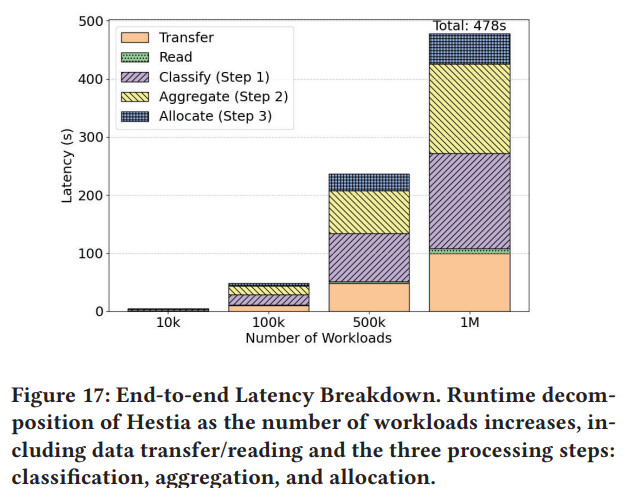
- Control overhead at million-workload scale (Figure 17). The complete pipeline scales approximately linearly with the number of workloads and processes one million workloads in 478 s. This timescale makes Hestia more appropriate for minute-scale, long-horizon oversubscription planning than for millisecond-scale online scheduling.
- Limitations of multi-resource aggregation. As the number of constrained dimensions increases, fewer complementary workloads satisfy every capacity constraint simultaneously. The profits for one-, two-, three-, and four-dimensional aggregation are 35.2%, 22.5%, 12.8%, and 5.1%, respectively. Thus, although the framework is conceptually extensible to multiple resources, the candidate space rapidly becomes sparse, and the single-resource gains cannot be carried over directly to multidimensional settings.
Q1: When solving this problem, have you encountered any extreme cases, performance bottlenecks or UD-related limitations, since the solution imposes restrictions on traffic?
A1: There is a configurable parameter in the aggregator to control the PCS (pair audacity competence score). If this parameter is set too high, the filtering standard for pair patterns will be overly strict, causing some layers to be missed and hurting overall performance. This parameter needs to be carefully selected based on historical data.
Q2: How often do you perform task bundling? If a random new task appears and is not bundled with other tasks, will violations still occur?
A2: Resource reallocation is triggered when obvious trends of workflows are observed, instead of running periodically. The system evaluates overall resource usage and SLA metrics to decide whether to perform reallocation.
Personal Thoughts
Hestia’s most valuable perspective is to treat workload composition itself as part of the oversubscription policy. Rather than only improving peak-demand prediction for each workload, it first flattens the aggregate demand curve presented to the Allocator and then determines a safe oversubscription level. This creates a complete causal chain from the source of volatility to resource profit. DWA captures the main benefit at low cost, while LSR refines the result only when additional control-plane budget is available—a practical design choice for large production clusters.
The main assumption is that historical periodicity will persist into the future. The paper reduces state oscillation by demoting a workload after an overload or SLA violation and requiring two consecutive detections before promoting it again, but unexpected traffic bursts, holiday-driven changes, and cold-start workloads may still weaken the assumption. The experiments also show clearly that additional resource dimensions rapidly shrink the space of aggregation opportunities. Future work must therefore address both faster detection of periodicity breakdowns and the construction of sufficiently complementary workload groups under joint CPU, memory, I/O, and network constraints.