Title: SaTE: Low-Latency Traffic Engineering for Satellite Networks
Authors: Hao Wu, Yizhan Han, Mohit Rajpal (National University of Singapore); Qizhen Zhang (University of Toronto); Jingxian Wang (National University of Singapore)
Scribe: Siyong Huang (Xiamen University)
Introduction
This paper studies the problem of traffic engineering (TE) in large-scale Low-Earth-Orbit (LEO) satellite constellations, such as Starlink. The challenge is that unlike terrestrial WANs with relatively static topologies, satellite networks experience extremely rapid topology changes (as frequent as every 70 ms) and fluctuating traffic demands. Existing TE algorithms designed for WANs are too slow (taking seconds to minutes) and cannot adapt to dynamic satellite environments, while current learning-based TE approaches require frequent retraining and consume excessive GPU memory. Solving this problem is important and interesting because satellite networks are rapidly expanding, supporting millions of users and critical services like internet access, IoT connectivity, and global communication. Efficient low-latency TE is crucial to ensure high throughput and reliable service delivery.
Key Idea and Contribution
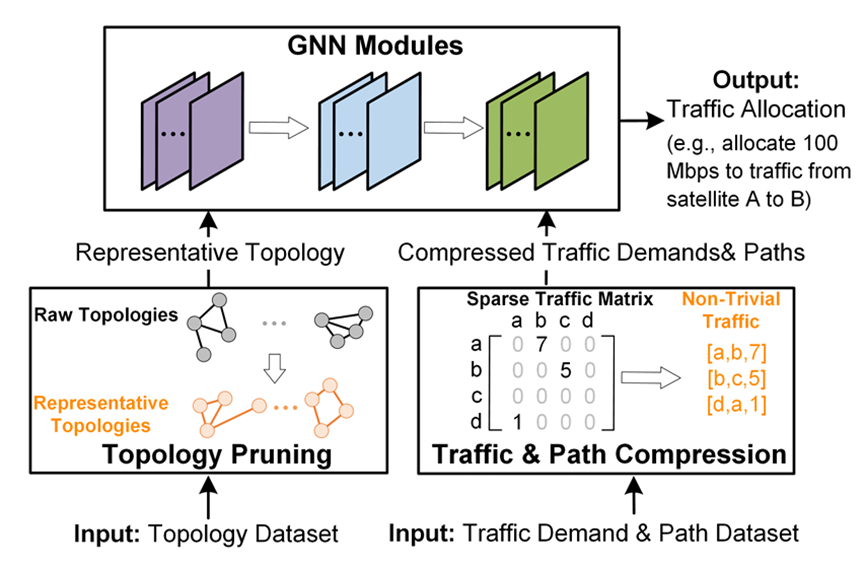
The authors propose SaTE, a low-latency traffic engineering algorithm tailored for dynamic satellite constellations. The key idea is to model the TE problem using a heterogeneous graph representation that captures satellites, traffic demands, paths, and inter-satellite links. Unlike prior works that require additional DNN layers, SaTE uses only Graph Neural Networks (GNNs), enabling generalization to unseen topologies without retraining.
SaTE also introduces dataset pruning techniques that effectively reduce training overhead. By removing idle paths and traffic in sparsely populated regions, as well as leveraging structural similarities among topologies to train on a smaller set of representative snapshots, SaTE is able to shrink the dataset size from hundreds of gigabytes to just a few megabytes. These innovations make it feasible to train on commercial GPUs while still maintaining high model accuracy.
Evaluation
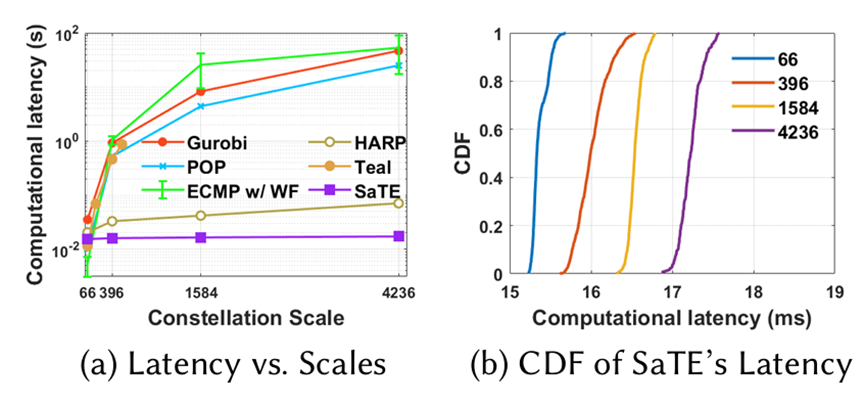
The authors evaluate SaTE on large-scale simulations of the Starlink constellation with 4,236 satellites, and the results are striking. SaTE achieves a computation latency of just 17 ms, representing a 2738× speedup over commercial solvers. In terms of throughput, it is able to satisfy at least 11% more traffic demand, with an average improvement of 23.5% compared to state-of-the-art methods. Moreover, SaTE demonstrates strong generalizability, successfully adapting to unseen topologies and scales while outperforming both heuristic and learning-based baselines. These findings are significant because they show that real-time traffic engineering is not only feasible in highly dynamic satellite networks but also capable of overcoming the limitations of existing approaches, thereby paving the way for scalable and efficient satellite internet systems.
Personal Thoughts
I find SaTE’s design elegant and pragmatic. By carefully modeling the TE problem as a heterogeneous graph, the authors manage to eliminate the need for costly retraining and avoid the scalability limitations of hybrid GNN+DNN designs. The pruning methods are particularly clever, making the solution feasible for extremely large constellations.
That said, some open questions remain. First, SaTE currently relies on supervised training with labels from commercial solvers, which may limit adaptability in scenarios where ground truth is hard to obtain. Second, the paper primarily evaluates throughput; other objectives such as fairness, latency guarantees, or resilience to link failures could be interesting to explore. Lastly, while SaTE shows promise in simulations, its performance in real-world satellite networks with unpredictable failures and noisy measurements remains to be validated.
Overall, I think this paper makes a strong and timely contribution to the field of satellite networking, bridging machine learning and traffic engineering in a practical way.