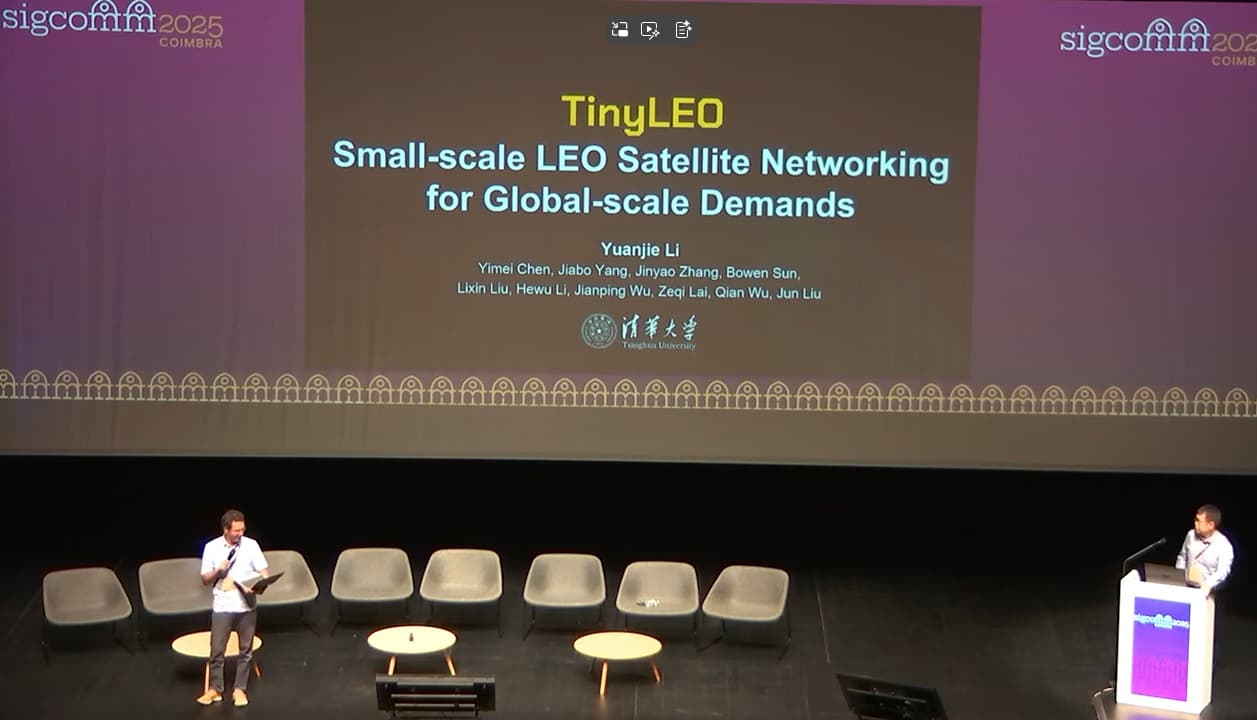
Title: Small-scale LEO Satellite Networking for Global-scale Demands
Scribe : Hongyu Du (Xiamen University)
Authors: Yuanjie Li (Tsinghua University, Zhongguancun Laboratory); Jiabo Yang, Jinyao Zhang, Bowen Sun, Lixin Liu (Tsinghua University); Hewu Li, Jianping Wu, Zeqi Lai, Qian Wu, Jun Liu (Tsinghua University, Zhongguancun Laboratory)
Introduction
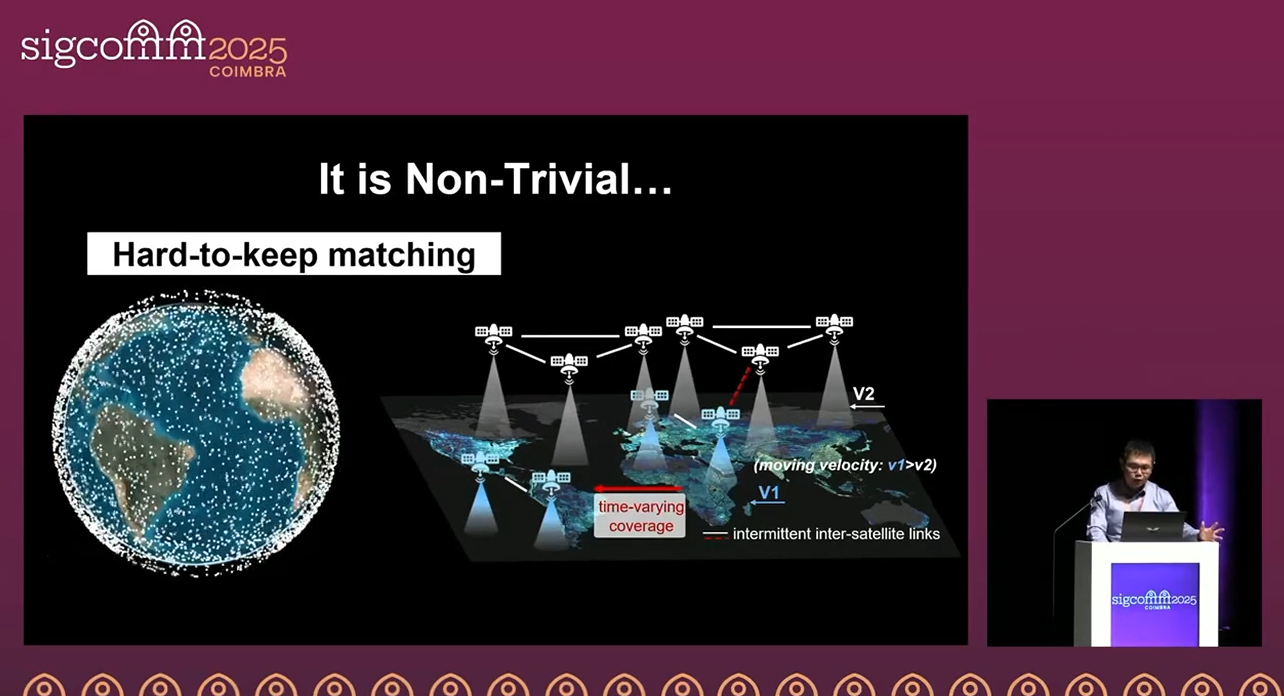
Although the current low Earth Orbit (LEO) giant constellation satellite networks (such as SpaceX’s Starlink and OneWeb) can provide high-speed global Internet access through a large number of satellites (for instance, Starlink has deployed approximately 7,000 satellites and 13,000 inter-satellite links), meeting the needs of over 4.6 million users, there are significant problems: First, the cost is high. The manufacturing, launching and operation expenses of satellites are unaffordable for most Internet service providers (ISPs) and countries, leading to the market being monopolized by a few tech giants and raising concerns among regulatory authorities and developing countries. The second is space congestion. A large number of satellites have exacerbated the congestion in low Earth orbit, threatening the sustainable and safe utilization of space. Thirdly, there is a waste of resources. The existing giant constellations mostly adopt uniform spatial distribution for easier management, while the global network demand is extremely uneven (over 70% of users are concentrated in 5% of land areas, and 70.8% of Marine areas have very few users), resulting in low satellite utilization in low-demand areas. Moreover, high-level load balancing (such as beam redirection and flow engineering) is physically restricted and cannot completely solve the problem of supply and demand mismatch. Against this backdrop, research needs to explore alternative solutions to reduce the scale of LEO networks, lower costs and space congestion, while retaining the availability, performance and resilience of giant constellations to meet the global demand for large-scale high-speed Internet.
Key idea and contribution :
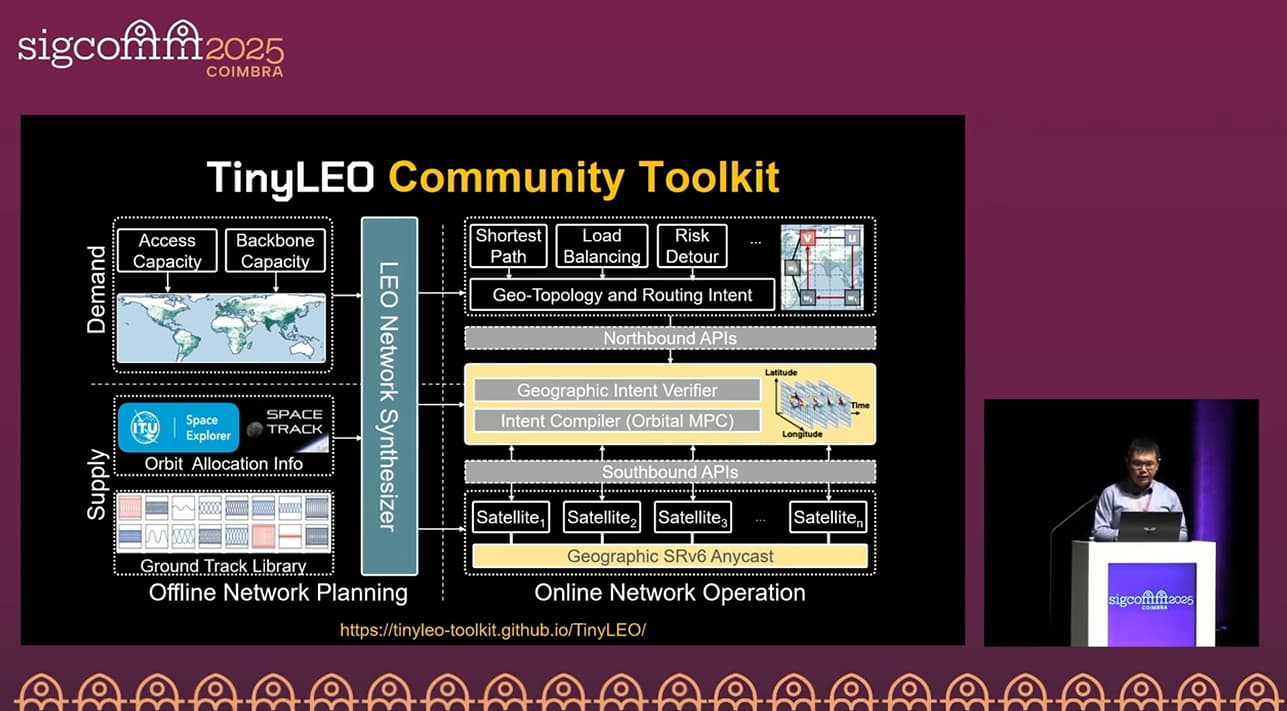
This paper proposes a software-defined solution named TinyLEO, aiming to reduce the scale of LEO networks through dynamic spatio-temporal supply and demand matching to meet global large-scale demands The core is to achieve the sparsification of on-demand satellite supply by combining diverse and sparse orbits, and to construct a sparse network layout based on the repetitive ground trajectories of satellites on Earth by using compressive sensing technology, reducing satellite redundancy in low-demand areas. In the control plane, the complexity of the sparse LEO network is concealed through orbital model predictive control (MPC), and the control plane is decomposed into a stable geographic traffic engineering intent and a dynamic network supply runtime compilation layer, reducing signaling overhead and enhancing orchestration flexibility. In the data plane, by leveraging geosegment anycast technology, the responsibility for handling network dynamics is transferred to the satellite local data plane, achieving compliant local routing, load balancing, and rapid fault recovery, while maintaining data plane performance comparable to that of existing giant constellations. In addition, this solution has been prototyping into an open-source community toolkit. Evaluations show that it can reduce the scale of existing LEO giant constellation networks by 2.0 to 7.9 times, lower the control plane cost by 1 to 3 orders of magnitude, and meet global broadband demands.
Evaluation
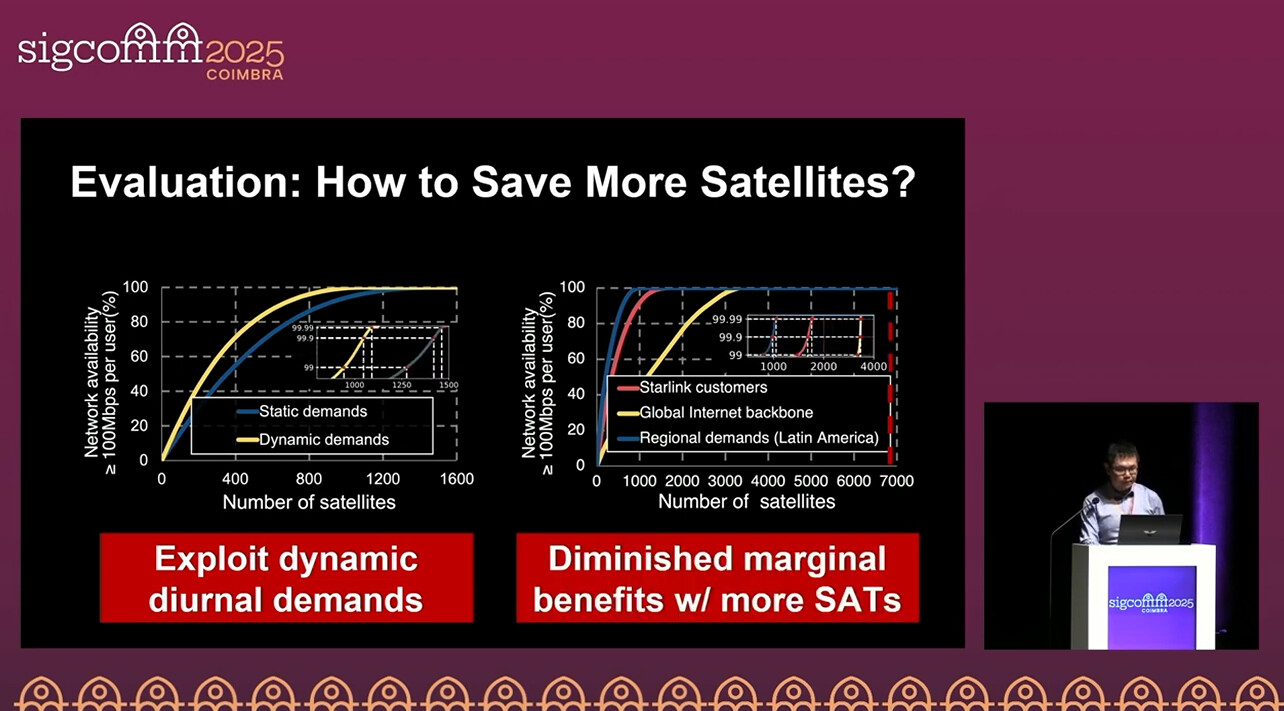
Experimental evaluations conducted through the TinyLEO community toolkit show that, under the condition of meeting the same global broadband demands (including the demands of Starlink users, the backup demands of the international Internet backbone network, and the demands of the Latin American region), TinyLEO can reduce the scale of the existing LEO giant constellation network by 2.0 to 7.9 times (for example, compared with Starlink’s 6,793 satellites, it can be reduced to 1,763, 3,344, and 1,066 respectively. If the network availability target is lowered to 99%, it can be further reduced). Moreover, the satellite waste rate is significantly lower than that of MegaReduce and Starlink, and the solution speed is much faster than that of Gurobi (6.5-7.7 hours to complete vs. Gurobi failed to complete in 2 months). On the control plane, compared with Aalyria’s TS-SDN, TinyLEO reduces the number of signaling messages by 1 to 3 orders of magnitude by stabilizing geographic intent and orbital MPC. It takes an average of 83.8 ms to repair 1,000 random link failures, which is superior to the recovery delay of TS-SDN. On the data plane, its geographical segment anycast based on SRv6 can correctly execute routing strategies such as the shortest path and transodiocean traffic offloading. The routing stretch rate is 1.29 at the 90th percentile. The end-to-end RTT is comparable to that of traditional IPv6, and the ISL utilization rate is close to full speed. Moreover, in the event of random ISL failures, a rapid recovery of 13.6 to 44.3 ms can be achieved through local rerrouting, maintaining overall data plane performance comparable to that of LEO giant constellations.
Q&A
Q :We all know that satellite orbits are limited, right? So in your plan, is there any difficult-to-achieve goal?
A : Our solution is attempting to simplify the process of deploying the solution on these project tracks. Nowadays, apart from Starlink, almost no operator can consider limited deployments due to the shortage of office resources. This is precisely why we are striving to reduce the number of satellites and deploy them to the Heater Genius office to build a network that is comparable in performance, smaller in scale but comparable in performance. This is precisely our design goal.
Personal thoughts
This paper focuses on the core pain points of the existing LEO giant constellation satellite network, such as high cost, market monopoly, space congestion and satellite waste caused by supply and demand mismatch, and proposes a TinyLEO software-defined solution centered on “spatio-temporal supply and demand matching”. Innovatively, through diversified sparse track combinations and compressive sensing, network sparsity is achieved, the track MPC simplifies the control plane, and the geographic segment anycast optimizes the data plane. This not only breaks through the technical bottlenecks of difficult dynamic supply and demand matching and complex networking in non-uniform LEO networks, but also lowers the research threshold through an open-source toolkit. The experiment verified the effectiveness of the solution from multiple dimensions such as network scale, control cost, and data performance, confirming that it can meet the global large-scale demand while significantly reducing the number of satellites and control costs. It not only provides an affordable satellite network solution for small and medium-sized ISPs and countries, but also contributes to the democratization of the market. It also provides a practical and feasible technical path for alleviating congestion in low Earth orbit and achieving sustainable utilization of space, which has significant theoretical and practical significance for the low-cost and sustainable development of the “space Internet”.