Title: Towards User-level QoE: Large-scale Practice in PersonalizedOptimization of Adaptive Video Streaming
Author: Lianchen Jia (Department of Computer Science and Technology, Tsinghua University, Simon Fraser University), Chao Zhou(Kuaishou), Chaoyang Li(Department of Computer Science and Technology, Tsinghua University), Jiangchuan Liu (Simon Fraser University), Lifeng Sun (Department of Computer Science and Technology, Tsinghua University, BNRist)
Scribe: Kexin Yu (Xiamen University)
Introduction:
The paper introduces LingXi, the first large-scale deployed system for personalized adaptive video streaming, aimed at optimizing Quality of Experience (QoE) for users in real-time. The problem tackled by this study is the stagnation of traditional optimization methods based on system-wide Quality of Service (QoS) metrics, which have reached their performance limits in large-scale streaming environments. The authors argue that focusing on user-level experience (QoE) offers a more effective solution. LingXi integrates user engagement data (like exit rates) to personalize adaptive video streaming, particularly in addressing stall events, which have the most significant impact on user experience.
Key idea and contribution:
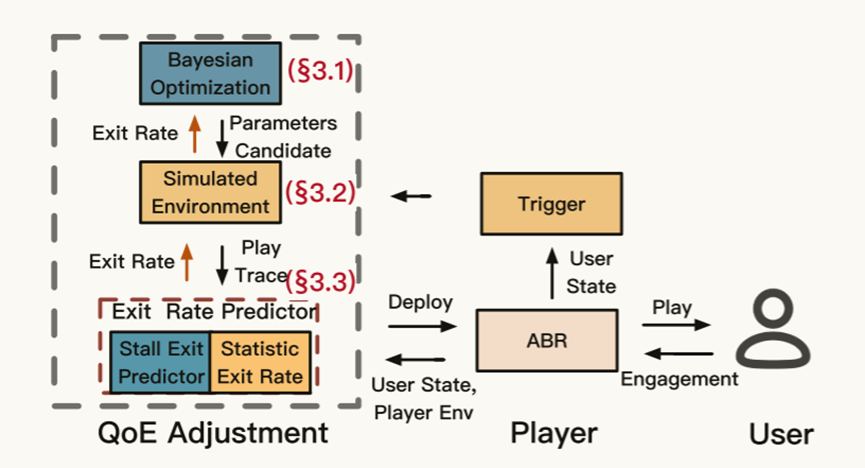
The key innovation of this paper is the transition from system-level QoS optimization to personalized user-level QoE optimization. The authors demonstrate that, by incorporating exit rates and using Bayesian optimization and Monte Carlo simulations, LingXi can personalize video streaming performance for each user in real-time, based on their interaction with the system (e.g., their sensitivity to stall events). The hybrid neural network model used for predicting exit rates further strengthens LingXi’s ability to adjust and optimize parameters based on individual user behavior, ensuring an overall improved QoE. The contributions of the paper include:
-
Proposing and implementing LingXi, which operates in real-time on a large-scale platform.
-
Demonstrating the importance of personalized optimization in improving user engagement in adaptive video streaming.
-
Showcasing that LingXi can be seamlessly integrated into existing ABR (Adaptive Bitrate) systems.
Evaluation:
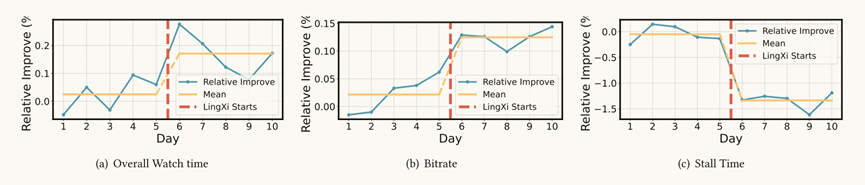
The paper presents a robust evaluation of LingXi’s performance through A/B testing conducted on Kuaishou, one of the largest short-video platforms. The results show that LingXi outperforms traditional approaches by:
- Increasing total watch time by 0.15%.
- Enhancing bitrate by 0.1%.
- Reducing stall time by 1.3%, with especially significant improvements for low-bandwidth users, reducing stall time by 15%.
This evaluation is substantial, with LingXi tested on 8% of Kuaishou’s traffic, making it a highly credible, real-world validation of the proposed system. The results also indicate that while LingXi doesn’t directly optimize QoS metrics, it dynamically adjusts parameters that indirectly improve them, such as bitrate and stall time.
Questions and opinions (1~2 para):
Q:
What is your primary objective? Is that the watch time or is that the stall because you did mention some users sensitive to stall?
A:
Collecting viewing duration data is time-consuming and makes it difficult to effectively evaluate the system through trade-off adjustments. Teams may focus more on exit rates than viewing duration. Users have varying sensitivities to stalls—some may exit due to stalls while others do not—so historical user responses must be leveraged to optimize the system.
Personal thoughts:
This paper achieves a significant breakthrough in adaptive video streaming by shifting focus from generic system-level metrics to individual user experience. Its practical implementation on large platforms like Kuaishou, combined with rigorous A/B testing, lends high credibility to the findings. The innovative approach of using exit rate as a key metric appears to effectively capture user engagement beyond what QoS indicators like bitrate and stutter duration can measure—an impressive insight. A noteworthy highlight is how LingXi dynamically adapts to varying user behaviors (e.g., differentiated adjustments for users with high jitter tolerance versus those sensitive to jitter). However, despite significant QoE performance gains, the relatively modest improvement in bitrate suggests LingXi prioritizes optimizing user engagement over maximizing video quality. This trade-off warrants careful consideration, particularly when balancing QoE and QoS objectives.